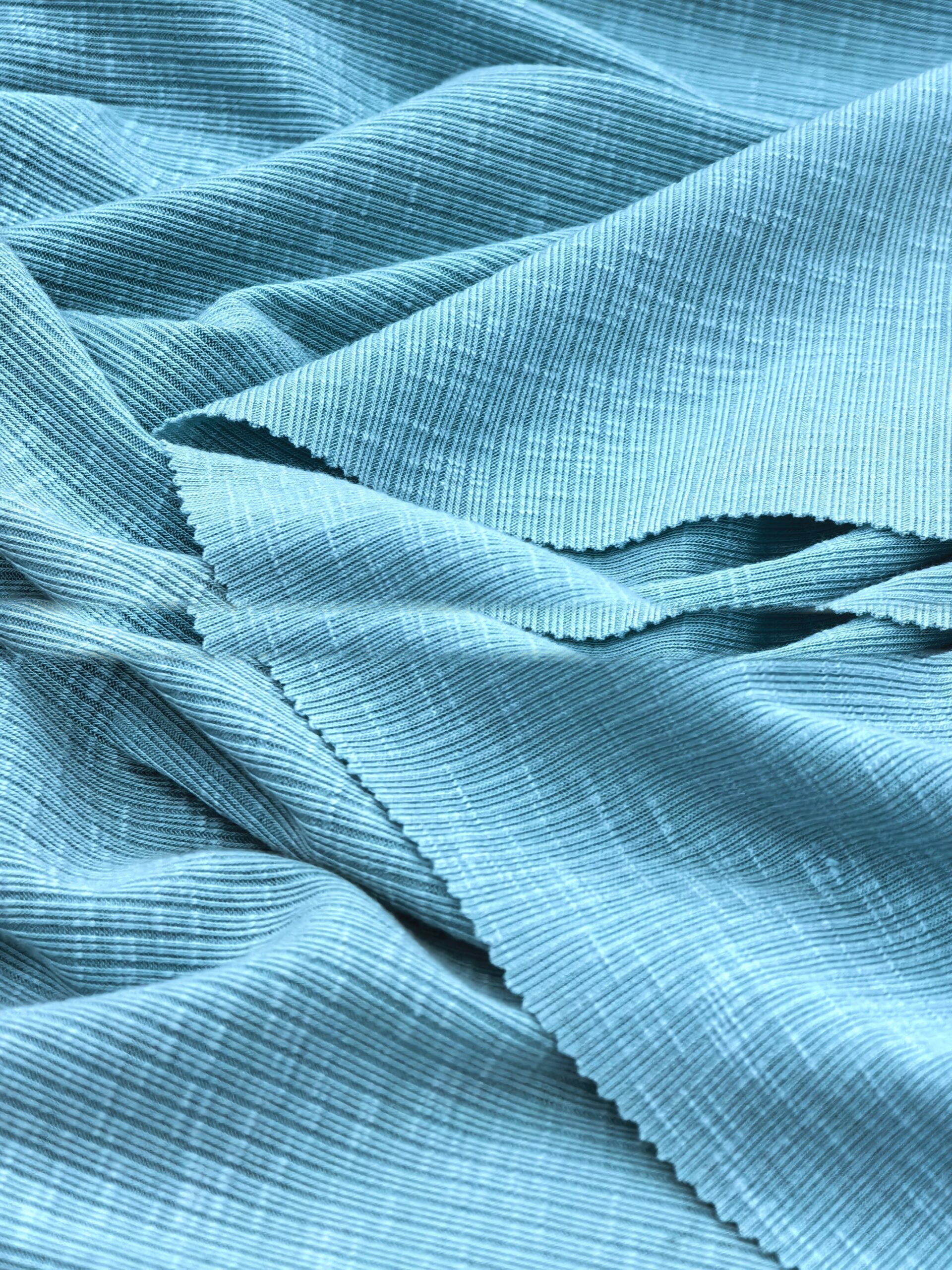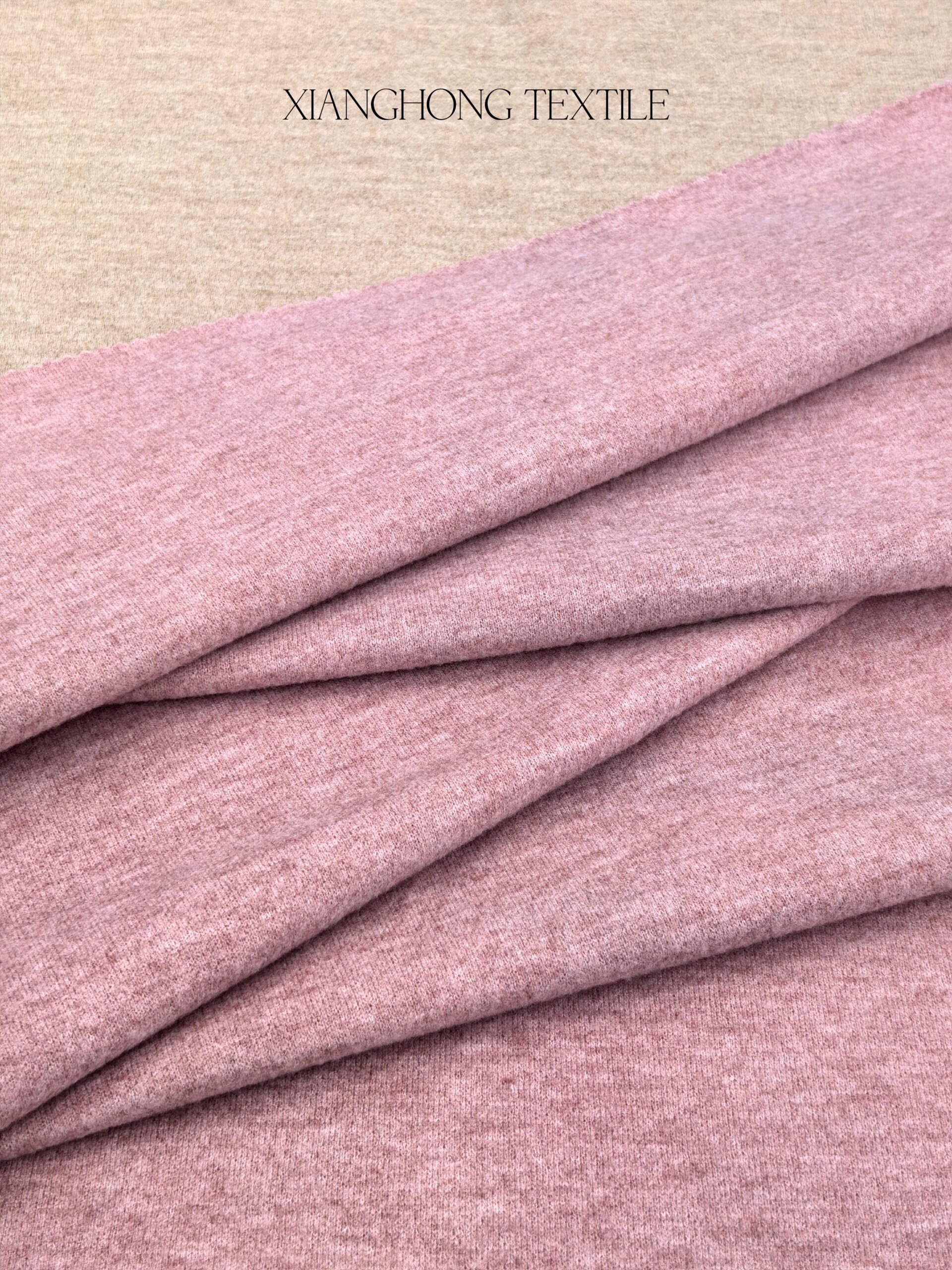
Two mills can quote the same “brushed sweater knit fabric” and deliver products that behave nothing alike. One holds a cardigan’s shoulder line for a whole season; the other sags by the second fitting. The difference is rarely the yarn — it is the base construction and how the brushing was done.
This is a construction-first guide for buyers and designers building autumn/winter womenswear: what brushing actually is, the four constructions the AW ranges we knit are based on, how nap direction changes your cutting room, and how to test a swatch in ten minutes.
What brushing actually does
Brushing (raising) drags fine wire rollers across the surface of a finished knit, lifting fibre ends into a nap. It does not change the structure underneath — which is why the base knit still decides how the garment behaves.
- Single-face vs. double-face. A face brush keeps the inside smooth and the outside soft; a double-face brush gives warmth and weight on both sides but adds cost and slightly more shedding.
- Peaching and sanding give a shorter, matte, suede-like surface — less loft than brushing, less pilling risk, and the better choice for a clean, minimal wool-touch look.
- Back-brushing leaves the face crisp and puts the warmth inside. Good for garment shapes that need a defined surface with a warm hand, such as button-through dresses and sets.
- Depth is the quality decision. Shallow, even brushing = short nap, low shedding, grade 4+ pilling. Deep brushing = instant luxury in the swatch, pills and sheds in the field.
Which construction for which garment
These four cover most AW womenswear briefs.
| Construction | GSM | Stretch & recovery | Best garment | Cutting note |
|---|---|---|---|---|
| Brushed hacci | 240–320 | Moderate stretch, good recovery | Knit dresses, soft cardigans, jumpsuits, layering tops | Loose hand: pre-shrink and check width post-wash |
| Brushed rib | 260–320 | High stretch, strong recovery | Fitted cardigans, turtlenecks, button-through dresses, co-ord sets | Rib relaxes out: confirm cuttable width after finishing |
| Heavyweight ponte | 250–350 | Low stretch, very stable | Knit dresses, wide-leg trousers, structured sets | Cuts like a woven; almost no curl, no lining needed |
| Brushed waffle | 260–320 | Low to moderate stretch | Cardigans, hooded knits, boxy dresses, outerwear-adjacent pieces | More yarn per m² than jersey: price per garment |
Brushed hacci is the drape option: a fine-gauge flat knit with an airy body, which is why it is the default for knit dresses and soft cardigans in a relaxed silhouette. It is also the construction most sensitive to brushing quality, so when you qualify a brushed hacci fabric supplier, judge the nap and the shedding first and the colour second.
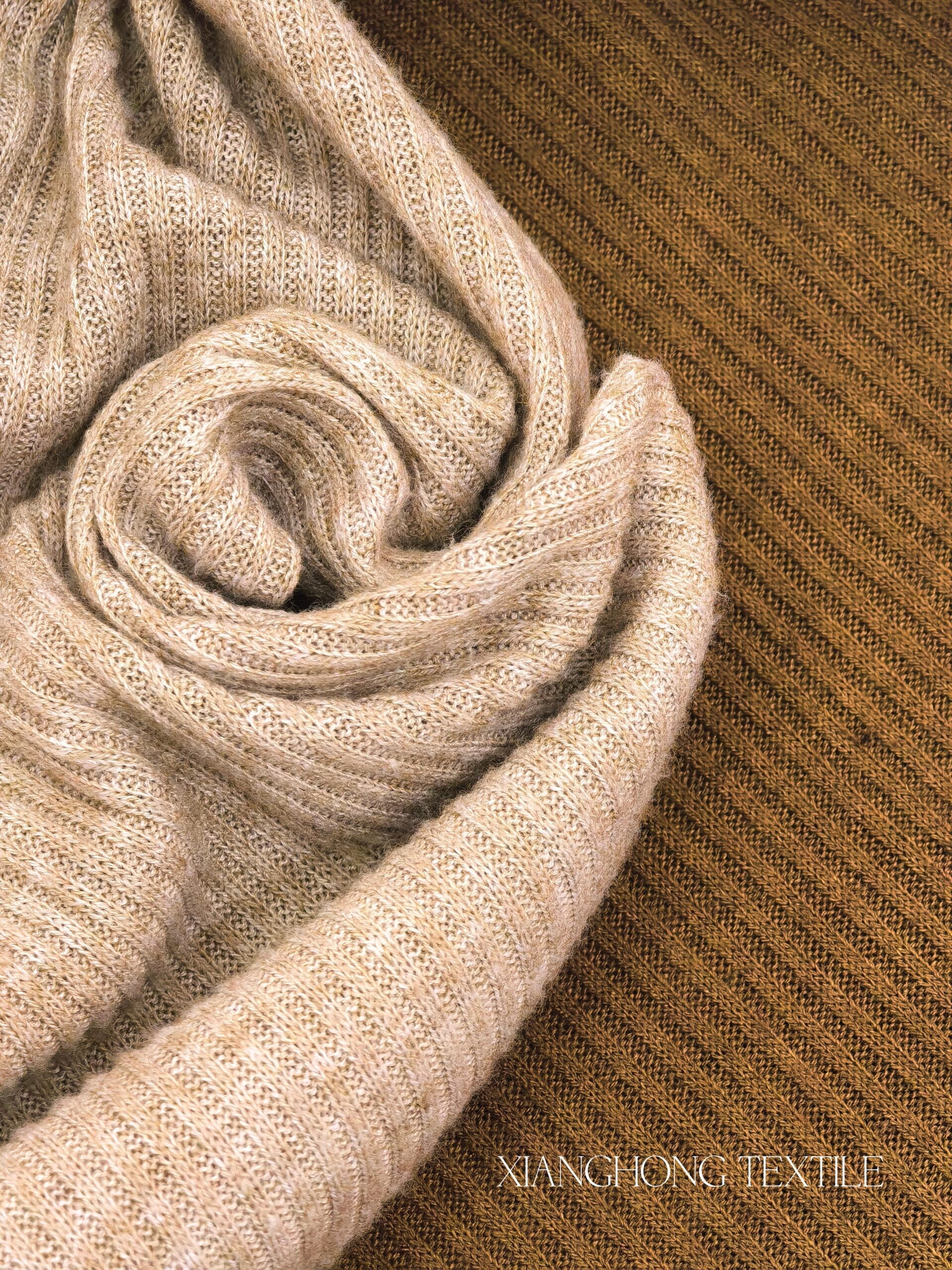
Brushed rib is the fit option. The rib supplies the vertical line and the snap-back that keeps a fitted cardigan from growing at the elbow, while the brushed face makes it warm. Avoid using deep-drop-needle ribs where the garment must lie flat under a jacket.
Heavyweight ponte is the tailoring option. Two interlocked faces give opacity and dimensional stability, so a ponte dress keeps its line without a lining — the reason it dominates structured sets and clean A-line shapes.
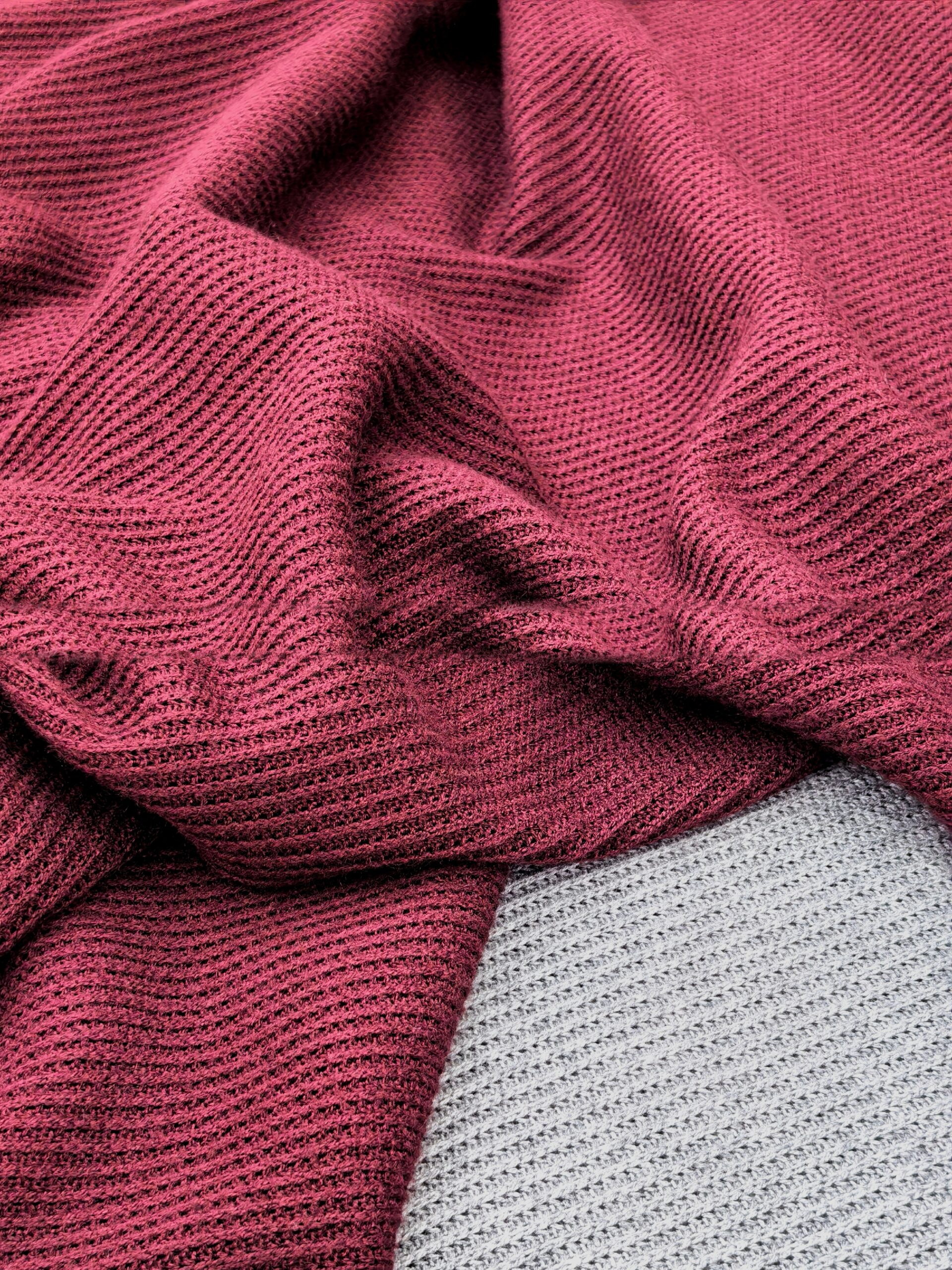
Brushed waffle is the texture option. The cell structure plus a brushed face reads expensive in photography and holds a cocoon shape. It is also the heaviest consumer of yarn, so compare it on cost per garment rather than cost per kilo.
Nap direction: the cutting-room rule that costs money
A brushed surface has a direction. Cut two panels from the same roll facing opposite ways and they will read as two different shades in daylight — visible on a finished garment and impossible to fix afterwards.
- Cut every piece in one direction. Mark the nap direction on the marker, not just on the fabric.
- Budget for nap consumption. A one-way marker needs more metres than a nested, two-way marker. Expect 5–15% more consumption on brushed qualities than on the same weight in plain jersey.
- Plan the marker on post-wash width. Our standard is 165 cm cuttable; four-way stretch and heavier constructions finish narrower, so take the exact width from the product page.
- Expect slight shade variation between rolls on heavy brushed qualities. Cutting all panels of one garment from one roll removes 90% of the risk.
Ready stock, sampling and custom dyeing
Brushed qualities are hard to judge on a screen, so the practical route is a physical swatch and then a small order.
- Ready stock brushed fabric for cardigans and dresses ships from our spot inventory in Keqiao, usually within 24–48 hours, in quantities from 1 roll (~25–35 kg). Small production runs and repeat lots are typically dispatched within 7–10 days.
- Custom dyeing starts at 500 kg per colour: lab dip in 3–5 days with Pantone matching, bulk in 10–15 days after you approve the dip.
- Composition and weight changes follow the same route — useful when you want a 300 GSM version of a 260 GSM stock quality for a coat-cardigan.
- Free A4 swatch cards and hangers, international freight collect, on request.
Sourcing from the mill rather than a trader matters here for a simple reason: the person who can change the brushing depth is the person who knits the roll. If you would rather compare the two supply routes, our note on in-stock versus custom dyeing sets out the trade-offs.
Test a brushed knit in ten minutes
- Nap check: hold the swatch against the light and stroke it both ways. Even, one-directional nap; no bare patches; no shadow lines.
- Shed test: press dark tape on the face, peel, repeat. Three rounds should progressively lift less fibre, not the same amount each time.
- Rub test: rub the fabric against itself 50 times and read the surface. Formed pills point to short staple or over-brushing.
- Recovery: stretch a 10 cm mark to 15 cm, hold 30 seconds, release, wait 30 minutes. Within about 5% of the original mark is a good result.
- Shrinkage: wash a 20 × 20 cm sample and re-measure both directions. Plan your marker on the post-wash width.
FAQ: brushed sweater knit fabric
Which brushed knit should I use for cardigans?
Brushed rib at 260–320 GSM for fitted and button-through cardigans, because the rib keeps the shape; brushed waffle or hacci at 280–320 GSM for oversized, relaxed cardigans. For a coat-cardigan, ask for a 300–350 GSM version of either.
Can you brush a fabric to my specification?
Yes. Brushing depth and face finish are set at the finishing stage, so we can produce a lighter or heavier nap on the same base construction, and confirm it on a lab dip before bulk.
What is the minimum order and lead time?
1 roll (~25–35 kg) from ready stock, dispatched in 24–48 hours; small runs in 7–10 days; custom-dyed colour from 500 kg per colour, with lab dips in 3–5 days and bulk in 10–15 days after approval.
Do you send swatches before I order?
Yes — free A4 swatch cards and swatch hangers, freight collect. A brushed fabric cannot be judged on a screen, and we would rather you feel it first.
Request swatches of all four constructions
Tell us the garment, the weight you are targeting and the colours you are working to. We reply within 12 hours (Mon–Sat) with stock availability, USD per kg pricing and lead times, and we will send a free A4 swatch hanger so you can compare the nap side by side.
Contact us → | WhatsApp us | Request a quote | See all 50 knit fabrics
Fabrics mentioned in this article
- #2602 Classic 3D Waffle Knit Fabric — 30% Polyester, 50% Rayon, 20% Nylon · 260 GSM · 165 cm
- #2209 Sculpted 3D Waffle Thermal Knit — 95% Polyester, 5% Spandex · 260 GSM · 165 cm
- #2170 Wide Chunky Ribbed Knit Fabric — 95% Polyester, 5% Spandex · 230 GSM · 160 cm
- #2421 Soft Mochi Cord Ribbed Stretch Knit — 57% Polyester, 20% Rayon, 5% Spandex, 18% Nylon · 280 GSM · 165 cm
- #2527 Brushed Fuzzy Starry Texture Knit — 92% Polyester, 8% Rayon · 280 GSM · 165 cm
- #2116 Tencel-Touch High-Drape Ponte di Roma Knit — 92% Rayon, 8% Spandex · 180 GSM · 165 cm
- #2518 Bark Crepe Texture Drape Knit — 70% Polyester, 25% Rayon, 5% Spandex · 280 GSM · 165 cm
Related reading
- Cashmere-Touch Knit Fabric: An AW Womenswear Development & Sourcing Guide
- Wholesale Cashmere-Like Knit Fabric from Keqiao: Low MOQ, Ready Stock and Custom Dyeing Explained
- GSM guide: choosing the right fabric weight for women’s knitwear
- Request a quote — reply within 12 hours (Mon–Sat)
- Bouclé, Cable and Chevron: How Loop and Transfer Stitches Build the Cashmere Look
- The Weight Ladder: Choosing 250–400 gsm Cashmere-Feel Knits by Garment
- From Roll to Garment: Cutting, Sewing and Pressing a Cashmere-Feel Knit Range