Twice a month a buyer sends us a swatch and asks us to match the “cashmere feel”. Nine times out of ten the swatch contains 2–3% wool. At 280 gsm that works out to roughly six grams of wool per square metre — less than the weight of a teaspoon of sugar spread across a pillowcase. Whatever that swatch is doing to your fingers, it is not the wool.
What you are actually feeling is air. Loops that trap it, floats that lift the surface, transfer stitches that double the fabric locally without adding weight. In our experience, the stitch architecture decides the hand long before the fibre list does. This article walks through the three structures we knit most often for autumn/winter womenswear, with the actual articles, weights and widths we hold in Keqiao.
Bouclé: loops that hold air
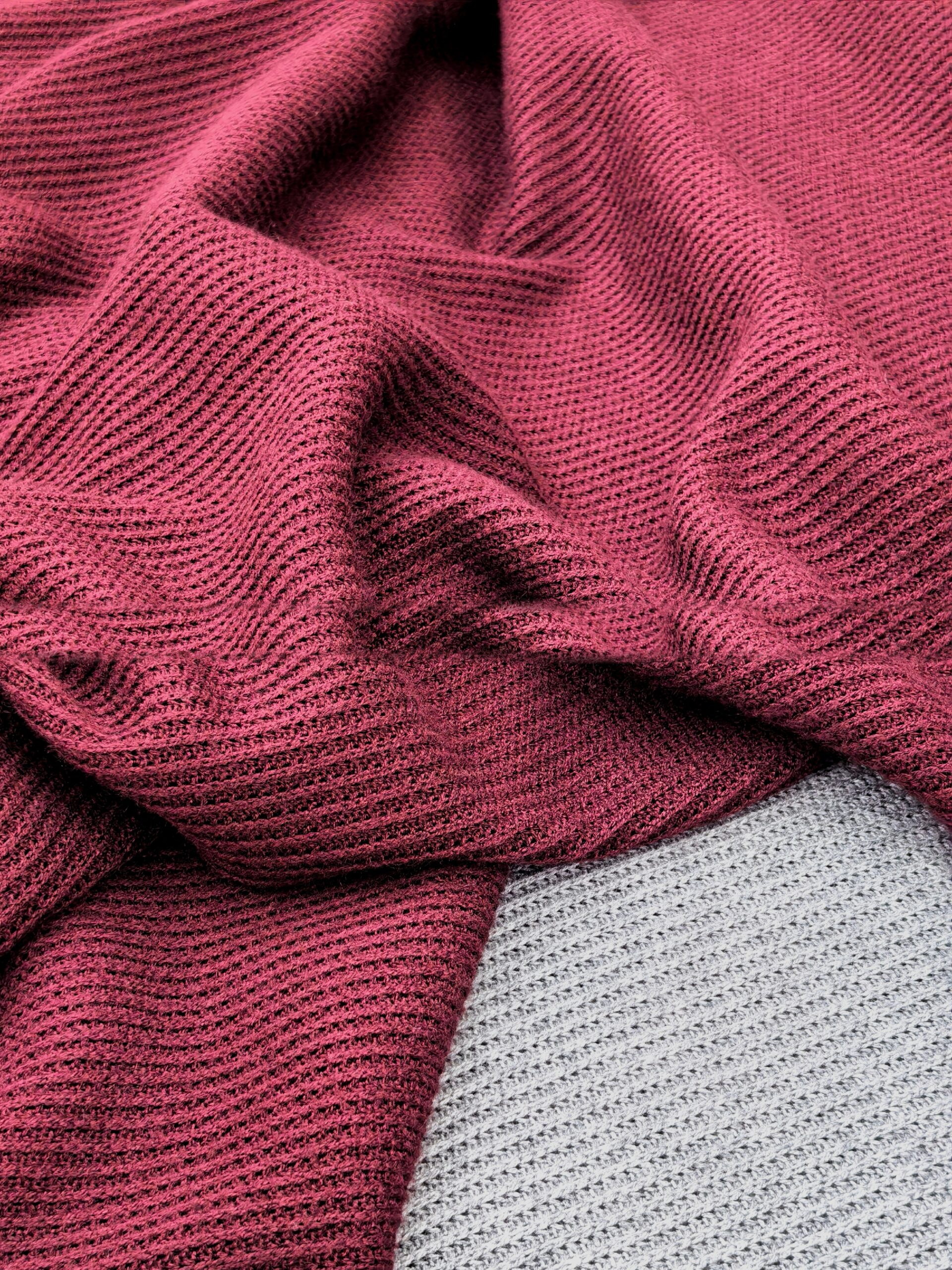
#2409 Boucle Wool-Blend Looped Knit is the closest thing we make to a fleece you can cut on a cutting table. The face is a field of small loops, not a brushed nap. That distinction matters: a brushed fabric raises fibre from an existing yarn; a bouclé knits a second, low-twist loop yarn into the ground so the loop is a physical structure that survives washing.
Specification as we knit it today: 71% polyester, 17% rayon, 5% nylon, 2% wool, 280 gsm, 165 cm usable width. The 2% wool is a hand modifier, not a performance claim. The nylon is doing the real work — it holds the loop shape so the surface does not collapse after three wears.
Where it fails: anything with a tight armhole or a narrow sleeve. Bouclé has bulk at the seam, and a 4-thread overlock on a 6 mm seam allowance will produce a ridge you can feel through the lining. We cut it with a 10 mm allowance and press the seam open on a sleeve board rather than flat. If your factory only has a flat bed press, expect a visible seam line on the inside.
Best garment: oversized cardigans, cocoon coats, sleeveless vests with a bound edge. Worst garment: fitted pencil skirts and any style with a waist seam.
Cable: bulk without weight
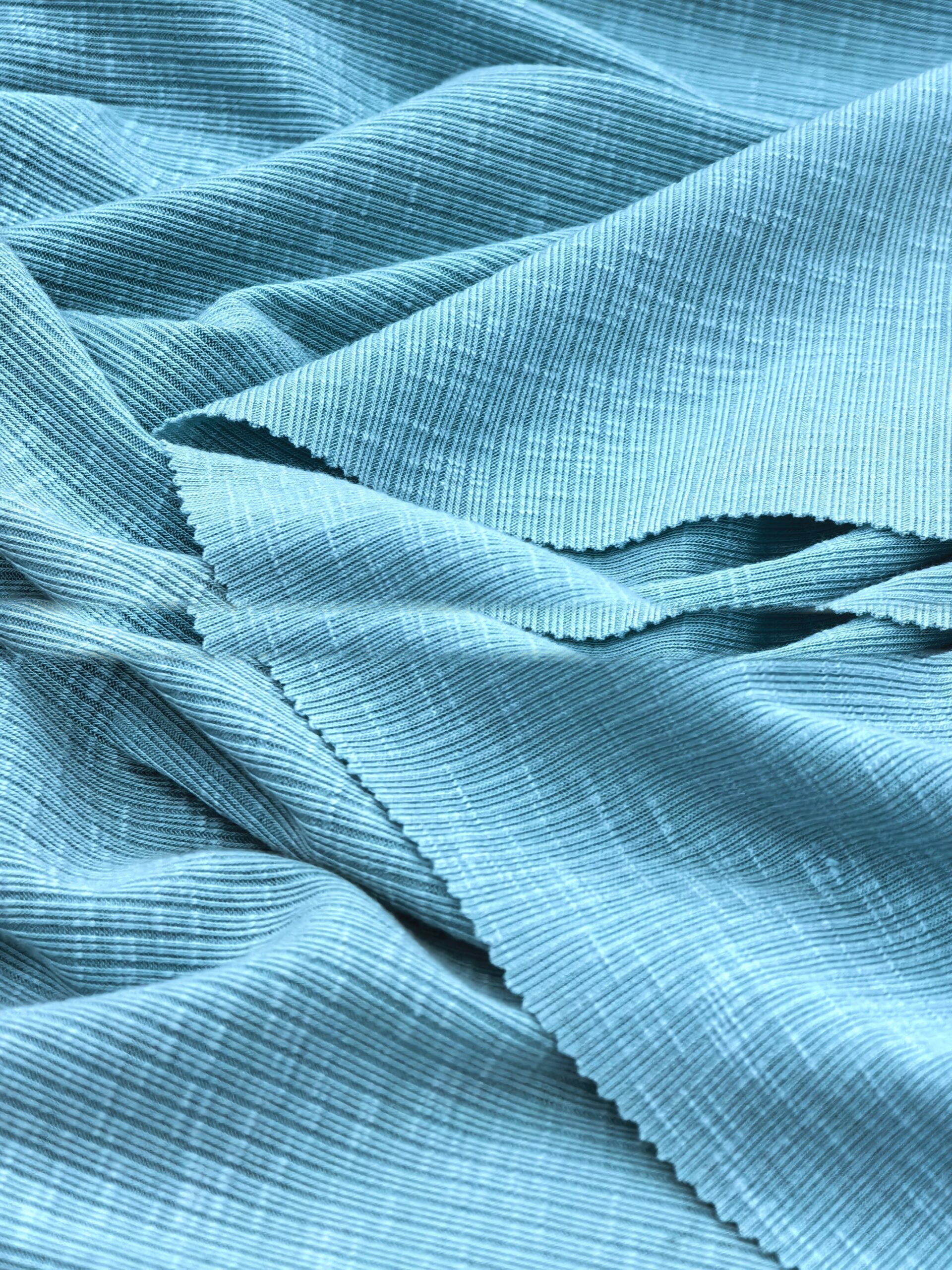
#2406 Classic Cable Texture Knit Fabric runs 71% polyester, 17% rayon, 5% spandex, 5% nylon, 2% wool at the same 280 gsm and 165 cm. The cable is formed by transferring stitches across needles, which pulls yarn from the neighbouring wales and builds a braid that stands proud of the ground.
The useful consequence is thermal: a cable ridge is locally two layers thick. A 280 gsm cable wears warmer than a 280 gsm jersey of the same composition because the ridge holds still air, and it does so without the drape penalty of going up to 350 gsm. That is why cable remains the default for a autumn cardigan that has to hang, not stand.
Two production notes. First, cable fabrics have a strong vertical grain; if your pattern is cut on the cross, the braid will run sideways and the garment reads as a mistake. Second, do not press the cable flat at the final press. Steam from 10–15 cm, then let it cool on a form. A flat press will erase the ridge permanently and you cannot recover it.
Best garment: V-neck and crew cardigans, sweater dresses, yoke detail on a plain body. Worst garment: anything needing a crisp front placket.
Chevron: the float that reads as tailoring
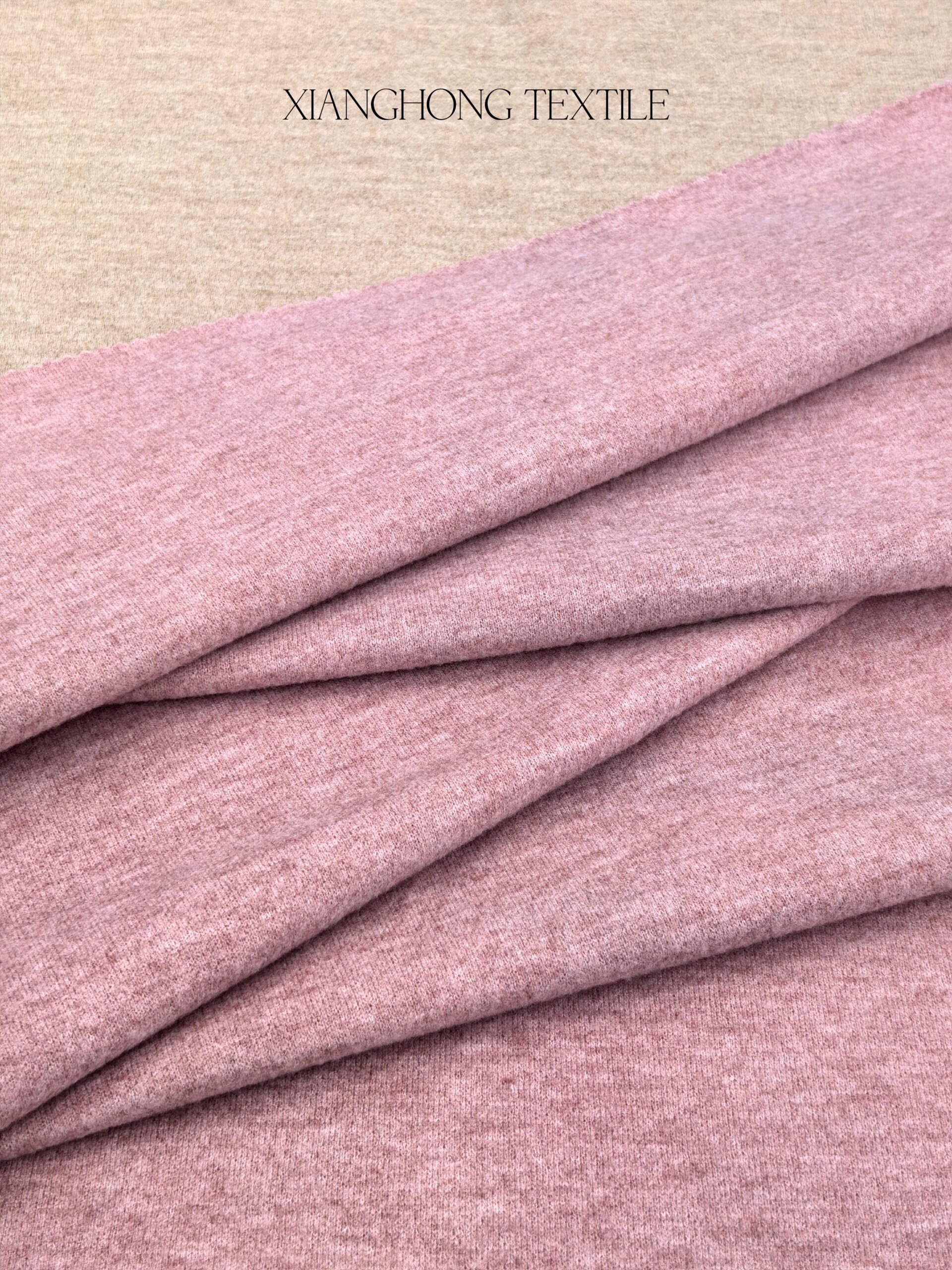
#2407 Chevron Arrowhead Texture Wool Blend Knit is 60% polyester, 27% rayon, 3% spandex, 3% wool at 280 gsm, 165 cm. The arrowhead is produced by floats — yarn carried across the back of the fabric for a controlled number of needles, then tied back into the structure.
Floats are where chevron fabrics earn or lose their money. Long floats snag on watch straps, ring settings and the velcro of a sample bag. We hold the float to five needles or fewer on the back. If a supplier quotes you a chevron with a much wider repeat, ask for a snag test before you commit — a 10 cm square rubbed against a velcro hook for twenty strokes will tell you more than any spec sheet.
Chevron is directional in a way cable is not. The arrow points up or down depending on how the panel is laid. Cut the front and back in opposite directions and the seam at the side will show a broken arrow that no amount of pressing will hide. Mark the grain with an arrow on every pattern piece, and check the first bundle before the cutter runs the lay.
Best garment: knit blazers, wide-leg trousers, A-line skirts, tonal column dresses. Worst garment: anything with a princess seam through the chevron.
When you need volume rather than drape
If the brief is a structured coat rather than a soft cardigan, the answer is usually not a heavier bouclé but a different structure altogether. #2260 Wheat Ear Texture Heavyweight Knit runs 300 gsm and 400 gsm at 160 cm. The wheat-ear column gives a vertical, almost woven appearance that holds a lapel line. It is the one fabric in this group we would put on a coat pattern without a fusible.
What to put on the purchase order
Most quality disputes on textured knits come from specifications that were never written down. For these structures we recommend stating, as a minimum:
- Weight tolerance: ±5% on the quoted gsm, measured on a 100 cm² cutter after relaxation.
- Width: 165 cm usable, with the selvedge excluded. State whether you need 160 cm minimum after wash.
- Shrinkage: length and width after one 40°C wash and tumble, expressed as a percentage, not as “low”.
- Pilling: Martindale, 2,000 revolutions, grade 4 minimum on the face.
- Colour fastness: to washing and to rubbing, grade 4 and grade 4 respectively for dark shades.
- Hand: a retained sealed swatch signed by both sides. This is the only hand specification that survives a season.
Stock, sampling and dyeing
All three structures are held as greige and in core colours in Keqiao. Spot orders ship from stock in 24–48 hours, and the minimum is one roll — roughly 25–35 kg, which is enough for a fit sample and a small production run. Custom dyeing runs from 500 kg per colour with a lab dip in 3–5 days and bulk in 10–15 days.
If you are still choosing between structures, ask for the A4 swatch hanger rather than a single cut. Bouclé, cable and chevron look similar on a screen and behave completely differently on a cutting table. The hanger ships free; you cover the freight.
Request a quote on #2409 bouclé — or send us the garment sketch and we will tell you which of the three we would knit it in, and which we would not.
Fabrics mentioned in this article
- #2409 Boucle Wool-Blend Looped Knit — 280 gsm, 165 cm, 71% P / 17% R / 5% N / 2% W
- #2406 Classic Cable Texture Knit Fabric — 280 gsm, 165 cm, 71% P / 17% R / 5% SP / 5% N / 2% W
- #2407 Chevron Arrowhead Texture Wool Blend Knit — 280 gsm, 165 cm, 60% P / 27% R / 3% SP / 3% W
- #2260 Wheat Ear Texture Heavyweight Knit — 300 & 400 gsm, 160 cm