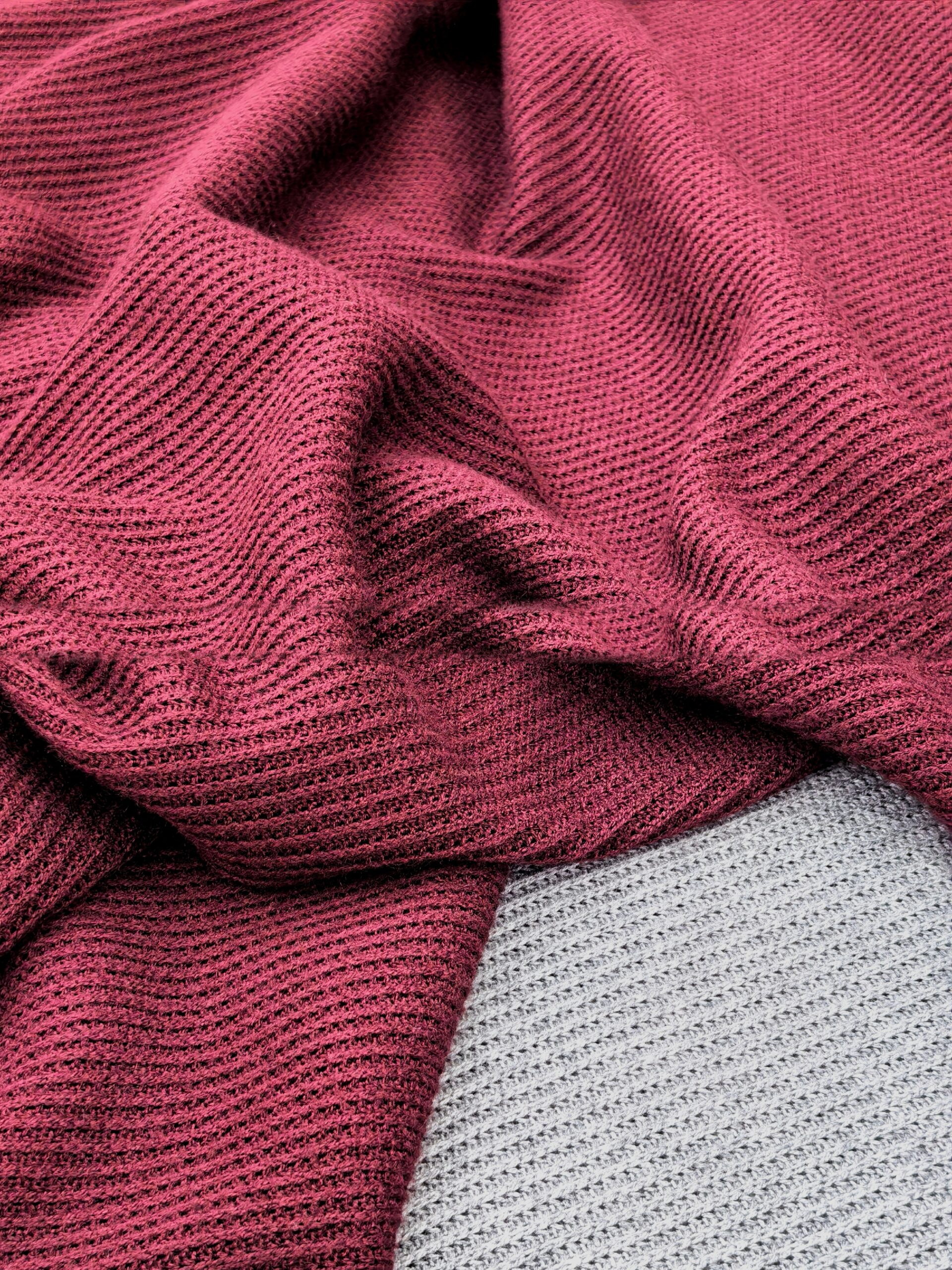
Most brands do not lose money on the price per kilo. They lose it on the order structure: buying 800 kg of a colour they cannot sell, or paying a trader’s margin on a fabric that was knitted twelve kilometres away.
This page explains how wholesale cashmere-like knit fabric is actually priced and supplied out of Keqiao — the three order tiers, why per-kilo and per-metre tell different stories, and how to use low MOQ sampling to de-risk a season.
The three order tiers
Almost every enquiry we receive fits one of three structures. Knowing which one you are in tells you the minimum, the lead time and the colour freedom you can expect.
| Tier | Typical quantity | Colour | Lead time | What it is for |
|---|---|---|---|---|
| Sample / test | 1 roll (~25–35 kg) | Stock colours from the warehouse | Dispatch in 24–48 h | Fit sample, wear test, salesman sample, small capsule drop |
| Small production / repeat | 300–500 kg | Stock colour, or topped up by dyeing | Typically 7–10 days | First production run, reorder, colour continuity on a repeat style |
| Full custom dye lot | 500 kg per colour and up | Pantone matched, lab dip approved | Dip 3–5 days, bulk 10–15 days after approval | Own palette, multi-style colour consistency, seasonal collection |
The trap is assuming you need tier 3 to launch. You usually do not: run the first drop in a stock colour, read the sell-through, and place the custom dye lot on the reorder — with real data behind the 500 kg commitment.
Sequenced properly, the three tiers fund each other. You buy one roll to prove the hand and the fit, place a 300–500 kg run to test the market in a stock colour, and only then commit 500 kg per colour to a palette you already know sells. Each step is cheap evidence for the next one.
How wholesale pricing actually works
Knit fabric is quoted per kilogram, but a garment is costed per metre, and the conversion is where margins hide.
- Heavier weight means fewer metres per kilo. A 280 GSM knit yields roughly 3.5 running metres per 10 kg at 165 cm width, against about 5.3 metres for a 180 GSM quality. Compare cost per metre, not cost per kilo, when moving between weights.
- Greige, dyed and finished are three different prices. Stock colours come out of a dye lot already run, so they carry no dyeing setup. A custom colour adds dyeing and a lab dip; a composition change adds yarn sourcing on top.
- Colour count matters more than total volume. One colour at 1,200 kg is cheaper per kilo than four colours at 300 kg, because the same dyeing setup is spread across more fabric.
- Ask what is included. Roll length, 4-point inspection, AZO-free reactive dyeing, packing and palletising, and whether testing for pilling, shrinkage and colour fastness is quoted separately.
- Payment terms and Incoterm. Expect a deposit with the balance against the bill of lading, or an irrevocable L/C at sight, and FOB Ningbo or Shanghai as the baseline Incoterm. Your landed cost depends on the port and the packing as much as on the fabric price.
- Sample credits. Ask whether the stock roll you buy for testing can be credited against your first production order. It is often negotiable at the sampling stage, and it is free to ask.
Why Keqiao, and why it lowers your minimum
Keqiao in Shaoxing, Zhejiang is the densest textile cluster in the world: yarn spinning, circular knitting, jacquard, dyeing and finishing within a few kilometres, and the ports of Ningbo and Shanghai about an hour away. As a women’s knitwear fabric manufacturer in Keqiao, that geography does three things for a buyer.
- It makes low MOQ possible. Stock qualities can be sold by the roll, because the mill is holding inventory it knitted for its own programme — not buying yarn to spec for every enquiry.
- It compresses lead time. Dyeing, brushing and finishing sit in the same building or next door, so a lab dip is a few days and a bulk lot is measured in weeks, not seasons.
- It removes the middle layer. Buying direct removes a trader’s margin and, more importantly, a trader’s filter: questions about brushing depth, GSM tolerance and width go to the person who can answer them.
Our own floor covers 8,000+ m² with 30+ circular and jacquard machines, which is what allows a one-roll sample to be followed by a genuine production slot. Our standard width is 165 cm cuttable, and every roll is 4-point inspected before dispatch. For context on why width is worth negotiating as hard as price, see our note on fabric width and marker planning.
It also keeps sampling cheap. Because yarn, knitting, dyeing, brushing and finishing sit within a few kilometres, a swatch, a lab dip and a test roll all come out of one cluster instead of three suppliers — and none of them waits on cross-border logistics before it is sent to you.
What to check in a wholesale quote — and what to send us
A complete quote answers six questions. If any of them is missing, the price is not comparable to the next one.
- Article number, composition and GSM — with the GSM tolerance the mill will hold.
- Cuttable width after finishing, not greige width.
- MOQ per colour and whether it is a stock or a dye-lot minimum.
- Lead time as three numbers: stock dispatch, lab dip, bulk production.
- Price basis: per kg and per running metre, plus what is included.
- Incoterm and port — FOB Ningbo or Shanghai is the usual baseline for export.
To get a same-day answer from us, send: the article number or reference, your target GSM and width, the colour (Pantone TCX or a physical swatch), the quantity in kg per colour, and where the goods are going. We reply within 12 hours (Mon–Sat) with stock availability, USD per kg pricing and lead times.
If this is your first order from a Chinese mill, the checklist in our sourcing knit fabric from China guide is a useful companion to this page, and our MOQ, lead times and lab dips note explains how the dip approval process protects the bulk lot.
FAQ: wholesale cashmere-like knit fabric
What is the MOQ for low MOQ knit fabric for sampling?
1 roll — roughly 25–35 kg from ready stock, which is enough for a fit sample, a wash test and a sales sample. Custom-dyed colour starts at 500 kg per colour.
How fast can you ship a wholesale order?
Stock rolls dispatch in 24–48 hours ex-Keqiao; small production runs and repeats are typically on the road within 7–10 days; custom dye lots run 10–15 days after lab-dip approval, with the dip itself in 3–5 days.
Can I mix colours in one order?
Yes. Stock colours can be mixed by the roll with no colour minimum. Custom colours are priced and minimumed per colour at 500 kg, so consolidating several styles onto one colour is the cheapest route to a full palette.
Do you send samples and a price list?
We send free A4 swatch cards and swatch hangers, freight collect, and price against your quantity and article numbers rather than publishing a static list — cashmere-like knit pricing moves with yarn and dye costs.
Get pricing and a swatch hanger
Send the article number, target GSM, colour and quantity in kg. We reply within 12 hours (Mon–Sat) with stock availability, USD per kg pricing and lead times — plus a free A4 swatch hanger so you can approve the hand before you commit a production budget.
Contact us → | WhatsApp us | Request a quote | See all 50 knit fabrics
Fabrics mentioned in this article
- #2538 Silk-Touch Wool Blend Fine Knit — 25% Polyester, 48% Rayon, 6% Spandex, 21% Nylon · 270 GSM · 165 cm
- #2527 Brushed Fuzzy Starry Texture Knit — 92% Polyester, 8% Rayon · 280 GSM · 165 cm
- #2610 Acetate Wool Blend Porcelain Texture Knit — 78% Polyester, 15% Rayon, 3% Acetate Wool, 4% Spandex · 280 GSM · 165 cm
- #2407 Chevron Arrowhead Texture Wool Blend Knit — 60% Polyester, 27% Rayon, 3% Spandex, 3% Wool · 280 GSM · 165 cm
- #2615 Melange Snowflake Textured Knit — 95% Polyester, 5% Spandex · 260 GSM · 165 cm
- #2367 Heavy Euro-Cotton Velvet Premium Knit — 95% Polyester, 5% Spandex · 380 GSM · 165 cm
- #2110 Emerald Fine Striped Stretch Knit — 95% Polyester, 5% Spandex · 180 GSM · 165 cm
Related reading
- Cashmere-Touch Knit Fabric: An AW Womenswear Development & Sourcing Guide
- Brushed Sweater Knit Fabric: Hacci, Brushed Rib, Ponte and Waffle Compared for AW Womenswear
- GSM guide: choosing the right fabric weight for women’s knitwear
- Request a quote — reply within 12 hours (Mon–Sat)
- Bouclé, Cable and Chevron: How Loop and Transfer Stitches Build the Cashmere Look
- The Weight Ladder: Choosing 250–400 gsm Cashmere-Feel Knits by Garment
- From Roll to Garment: Cutting, Sewing and Pressing a Cashmere-Feel Knit Range