A rich surface can sell the first sample and still ruin the bulk order. The failure usually starts after the fabric has been approved: a plaid that cannot be matched across the centre front, a drop-needle panel that catches on a watch, or a metallic yarn that produces a different visual weight on the sleeve than on the body.
Jacquard, embossed, crepe, waffle, lurex and drop-needle fabrics are not plain goods with more texture. Each has a rule that starts at the knitting machine and finishes at the marker. If those rules are not written into the technical pack, the factory may make a technically correct garment that reads as a mismatched collection.
The 16 articles in this guide are the surface-led portion of our current 50-piece knit range. Some deliver a wool-touch or cashmere-like impression through relief and air rather than fibre content; others use pattern, metallic yarn or openwork as the visual point. The selection logic below is organised by how the surface behaves on a cutting table and on the body.
Four surface types, four different buying questions
Before comparing colour, separate the articles into the four groups below. Two fabrics can look equally “textured” on a screen and require completely different controls in production.
- Pattern-built jacquards: the motif is knitted into the cloth, such as a plaid or a small geometric pattern.
- Relief and crepe surfaces: the structure creates raised or recessed areas that catch light, with no printed motif to register.
- Directional linear structures: stripes, waves and ribs that need a grain or repeat decision on every pattern piece.
- Metallic and openwork surfaces: lurex, drop-needle and sparse structures where snagging, coverage and yarn damage matter more than a flat hand.
Pattern-built jacquards: the repeat controls the cost
#2208 Textured Plaid Check Jacquard Knit is 280 gsm at 160 cm. A plaid creates at least two alignment problems: the vertical lines at the centre front and side seam, and the horizontal lines across the bust, waist and pocket.
A symmetric plaid can be placed so the centre front falls on a line or between two lines. Those are different design decisions, not interchangeable cutting instructions. Mark the intended position on the pattern and add a match allowance to the marker. If the fabric is cut to the last centimetre without that allowance, the factory may either break the match or lose a garment from the lay.
The commercial calculation is straightforward. If the pattern repeat is 12 cm and the marker length is 240 cm, the lay can hold 20 repeats. Increase the marker to 250 cm and the next repeat may take it to 252 cm. The loss is not the 12 cm motif itself; it is the unused length created when every graded piece must start and finish on the repeat.
The check and jacquard surface should also be reviewed at garment scale. A 5 cm swatch can make the pattern look balanced, while a full front panel may reveal an unintended large motif across the bust. Ask for a metre cut, not only an A4 card, when the pattern repeat is a selling point.
Relief surfaces: where light replaces print
#2202 Floral Embossed Texture Rib Knit is 220 gsm at 155 cm. The narrower width and raised floral texture make it a different cutting proposition from a 165 cm flat rib. The relief creates shadow, but it also creates thickness at folds, cuffs and seams.
#2610 Acetate Wool Blend Porcelain Texture Knit is 280 gsm at 165 cm. Its clean porcelain-like surface is useful when the collection wants a wool-touch mood without a heavy loop or brush. It can support a soft knit blazer, a pencil skirt or a dress with a clean front, but the relief should be checked after pressing; too much heat can flatten the surface and change the hand.
#2518 Bark Crepe Texture Drape Knit is 280 gsm at 165 cm. Crepe texture can hide seam shadows and reduce the flat look of a simple dress, but it can also increase surface friction in a lining. If the garment is lined, test the two surfaces together before selecting the lining quality.
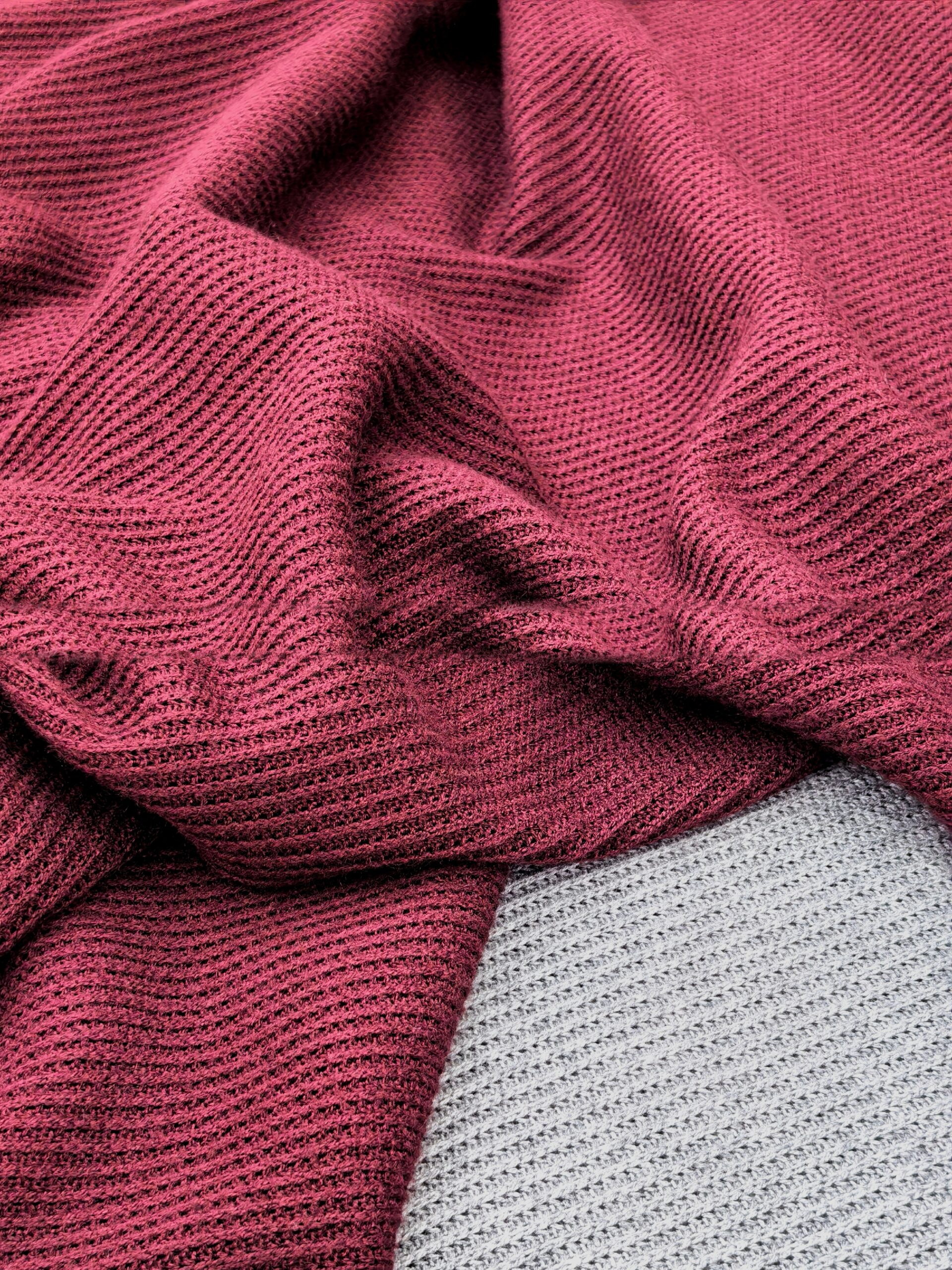
#2602 Classic 3D Waffle Knit Fabric is 260 gsm at 165 cm. A 3D waffle holds air and creates a strong shadow, which can make a knit cardigan or dress feel more substantial at the same measured weight. The deeper relief needs a seam sample: a flat seam that works on jersey can look compressed beside the waffle grid.
Directional lines: decide the grain before the marker
Directional knits are the easiest group to underestimate. The swatch is beautiful, but every pattern piece has to state whether the line runs vertically, horizontally or on a deliberate angle.
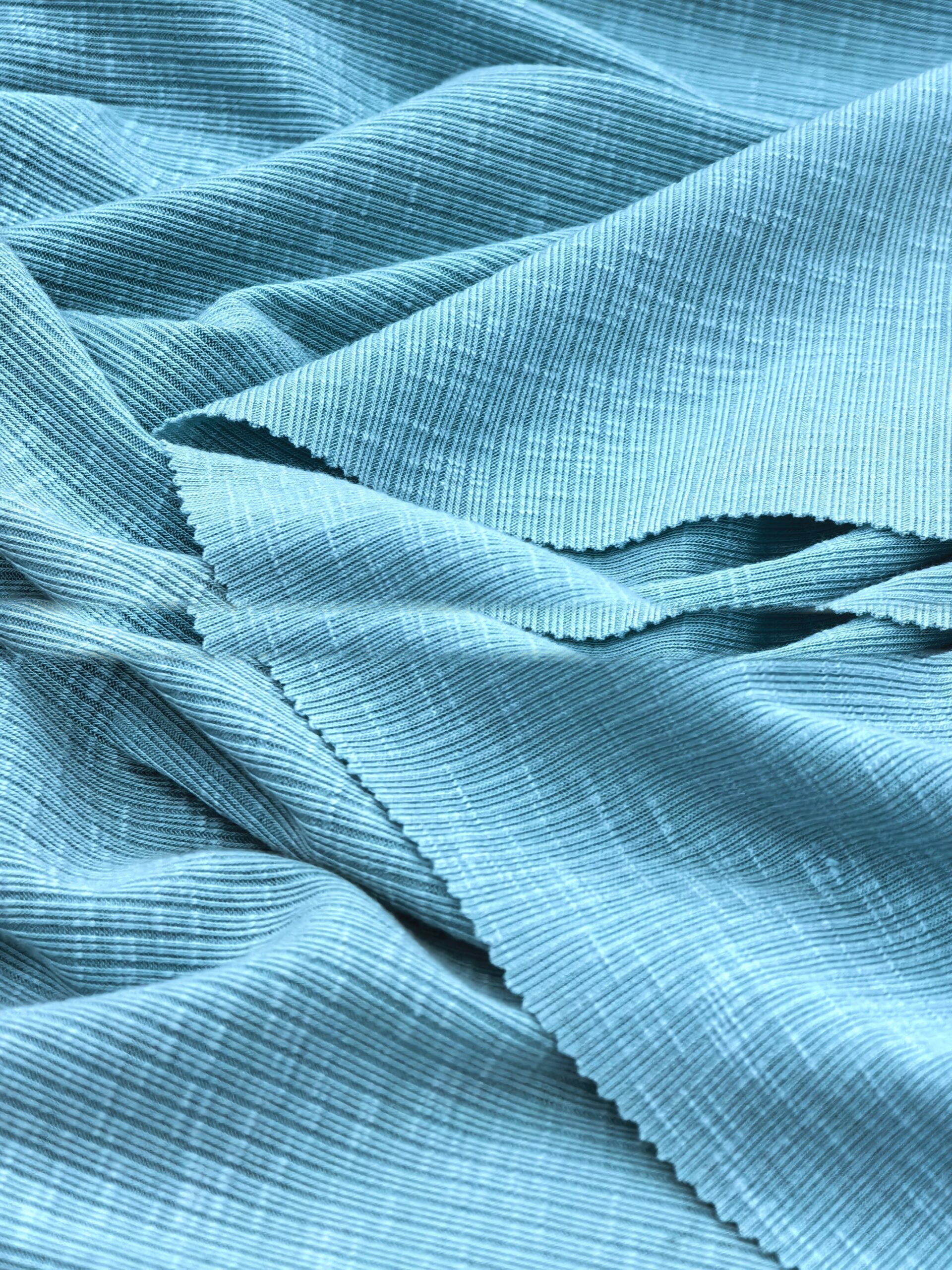
#2362 Rich Textured Vertical Stripe Knit is 280 gsm at 165 cm. Vertical lines can lengthen a dress or cardigan, but they must continue in a believable direction across the side seam. If the front is cut down the grain and the back is cut across it, the seam will show a broken line even if the colour is correct.
#2305 Meteor Streak Texture Stretch Knit is 220 gsm at 165 cm. A diagonal or irregular streak creates movement. Place it on a full front panel before approving the pattern position; a small cut can make the direction look accidental rather than designed.
#2327 Euro-Cotton Velvet Striped Warm Knit is 300 gsm at 165 cm. The heavier weight and stripe direction make it suitable for a cardigan or a structured skirt, but not for a full gathered dress unless the stripe is meant to create horizontal volume.
#2360 Textured Wave Stripe Stretch Knit is 260 gsm at 165 cm. A wave repeat can create a deliberate optical effect, but it is very sensitive to panel placement. Decide whether the waves should mirror at the side seam or continue continuously. There is no universal answer; the tech pack must choose.
#2539 Crinkle Texture Willow Stripe Knit is 280 gsm at 165 cm. Crinkle and willow-stripe surfaces reduce the need for print, but they can make seam pressing difficult. Use a sample seam and test whether the surface becomes flat or shiny at the seam line.
#2399 Diamond Twill Rayon Spandex Stretch Knit is 280 gsm at 165 cm. The diamond twill is subtler than a plaid, but it still has a direction. It can be a good bridge between a plain wool-touch jersey and a stronger statement surface for a dress or skirt.
Slub and melange: surface variation without a repeat
Slub and melange articles can look simpler to cut because there is no motif to match. They still need a panel-scale check. A slub that reads as a subtle irregularity in a sleeve can become a strong horizontal band across a dress front.
#2621 Sesame Speckled Melange Slub Knit is 280 gsm at 165 cm. The speckled surface is a useful option for a soft cardigan or a simple dress when the collection needs texture without metallic yarn. Approve the contrast level on the full colourway, not only on an undyed swatch.
#2521 Japanese Style Slub Knit Jersey is 280 gsm at 165 cm. The slub surface can support a relaxed tee, soft shirt-jacket or simple dress, but the grain and surface direction should be consistent across front and back panels. Keep the cut sample because the slub pattern cannot be recreated from a verbal description.
Metallic and drop-needle surfaces: snagging is a garment risk
Lurex and openwork surfaces are visually effective because they change the way light travels through the fabric. They also create two production risks: yarn damage and snagging. A smooth ring, watch clasp or sample-bag hook can pull a metallic yarn or catch a drop-needle opening.
#2607 Metallic Yarn Shimmer Rib Knit is 200 gsm at 165 cm. The shimmer gives a fine surface accent for a fitted top or a skirt. Ask for a snag test using a standard hook-and-loop tape and a run test after washing; a clean first swatch does not prove that the metallic yarn is secure at a seam.
#2418 Silver Shimmer Lurex Starry Knit is 220 gsm at 165 cm. The starry surface is more open than a plain rib, so line placement and undergarment colour should be checked before it is used for a close-fitting dress. If the style needs a full lining, the lining must not create a contrasting grid through the open areas.
#2605 Premium Drop-Needle Ribbed Knit is 230 gsm at 165 cm. Drop-needle openings can make a lightweight knit look expensive, but they also change the cutting direction. A panel cut across the openwork may collapse or stretch differently from one cut along the grain. Mark the pattern direction and inspect the first cut bundle before the lay is run.
Pattern alignment and marker loss: a worked example
The true cost of a patterned knit is understood only when the marker is drawn. Consider a dress with a front panel, back panel and two sleeves. A plain fabric may fit the largest size across the width once. A plaid or directional stripe may require the side seams to be positioned on matching lines and the sleeves to start at the same motif.
If the repeat is 10 cm and the front panel must begin at a specific line, the cutter may need to move the next size 3–4 cm along the cloth. At the end of a 6 m lay, that can turn into an extra half repeat or a lost panel. The quotation must allow for:
- pattern repeat length and width;
- a match allowance at the centre front and side seam;
- a spare piece for the pocket, placket or sleeve;
- directional arrows on every pattern piece;
- the largest size in the range, not only the base sample.
This is also why a 155 cm #2202 and a 160 cm #2208 cannot be compared to a 165 cm plain fabric by width alone. The pattern restriction, not the nominal width, determines the number of garments in the marker.
Garment placement: where each surface earns its price
The easiest way to avoid an over-designed collection is to assign one surface role per style:
| Surface | Strong placement | Avoid |
|---|---|---|
| Plaid jacquard #2208 | Straight cardigan, structured skirt, simple shift dress | Multiple curved seams that break the grid |
| Embossed floral rib #2202 | Fitted cardigan, short jacket, neat skirt | Large gathered panels that crush the relief |
| Porcelain texture #2610 | Soft blazer, column dress, clean skirt suit | Over-pressing or heavy seam bulk |
| 3D waffle #2602 | Cardigan, thermal top, simple knit dress | Narrow folded trims with too many layers |
| Vertical stripe #2362 | Long dress, open cardigan, trousers | Opposing grain at a visible side seam |
| Drop-needle #2605 | Light cardigan, sleeve or yoke accent | High-friction bags and exposed watch hardware |
| Metallic #2607 / #2418 | Evening top, skirt, narrow accessory panel | Heavy abrasion at a tight cuff or bag strap |
| Slub #2621 / #2521 | Relaxed dress, cardigan, soft shirt-jacket | Patterns that depend on perfectly uniform surface |
The role should be visible from three metres away. If two surfaces compete in the same garment, the customer may not know where to look; if the surface is too subtle for its position, the development cost is not returned at retail.
What to test before bulk
For every surface in this group, we would ask for a constructed sample rather than a loose swatch alone:
- Pattern: full-panel photo under the intended colourway and lighting.
- Marker: largest-size placement with repeat and direction marked.
- Seam: side seam, centre front and armhole after pressing.
- Surface: snag test, pilling test and hand after two wash cycles.
- Colour: face and reverse side compared under a defined light.
- Recovery: stretch at the cuff or body, measured after release.
- Retained sample: sealed against the bulk lot, not only a phone image.
For metallic and drop-needle surfaces, add a wear test with the actual accessories used in the lookbook. A fabric can pass a laboratory abrasion test and still catch on a specific bracelet in the studio.
Stock, low-MOQ sampling and custom colour
The surface-led articles in this guide can be sampled from the current stock range. Ready-stock orders start at one roll, approximately 25–35 kg. Custom dyeing starts at 500 kg per colour. Free A4 swatch cards and hangers are available; freight is collected.
When a patterned surface is being developed for a custom colour, keep the pattern and colour approvals separate. A lab dip can match the ground shade while the metallic yarn or contrast motif remains outside the dye recipe. Approve the complete face, not just the base cloth.
Send the pattern and garment placement with the intended article number, order quantity and required repeat position. We can shortlist from the 50-piece range and arrange swatches before a custom dye or bulk commitment.
Surface-range articles mentioned
| Article | Fabric | Weight | Width |
|---|---|---|---|
| #2621 | Sesame Speckled Melange Slub Knit | 280 gsm | 165 cm |
| #2208 | Textured Plaid Check Jacquard Knit | 280 gsm | 160 cm |
| #2202 | Floral Embossed Texture Rib Knit | 220 gsm | 155 cm |
| #2362 | Rich Textured Vertical Stripe Knit | 280 gsm | 165 cm |
| #2305 | Meteor Streak Texture Stretch Knit | 220 gsm | 165 cm |
| #2327 | Euro-Cotton Velvet Striped Warm Knit | 300 gsm | 165 cm |
| #2399 | Diamond Twill Rayon Spandex Stretch Knit | 280 gsm | 165 cm |
| #2518 | Bark Crepe Texture Drape Knit | 280 gsm | 165 cm |
| #2360 | Textured Wave Stripe Stretch Knit | 260 gsm | 165 cm |
| #2607 | Metallic Yarn Shimmer Rib Knit | 200 gsm | 165 cm |
| #2418 | Silver Shimmer Lurex Starry Knit | 220 gsm | 165 cm |
| #2605 | Premium Drop-Needle Ribbed Knit | 230 gsm | 165 cm |
| #2602 | Classic 3D Waffle Knit Fabric | 260 gsm | 165 cm |
| #2539 | Crinkle Texture Willow Stripe Knit | 280 gsm | 165 cm |
| #2521 | Japanese Style Slub Knit Jersey | 280 gsm | 165 cm |
| #2610 | Acetate Wool Blend Porcelain Texture Knit | 280 gsm | 165 cm |
These 16 surface-led articles complete the current 50-piece range when read alongside the cardigan and dress selections. Browse all in-stock knit fabrics or use the category pages to compare plain, textured and metallic options side by side.
Related reading
- Cashmere-Feel Cardigan Knit Fabric: GSM, Rib Recovery and Trim Width
- Knit Fabric for Wool-Touch Dresses: Drape, Coverage and Lining
- How Loop, Cable and Chevron Stitches Build the Cashmere Look
- Lurex Knit Fabrics: Autumn/Winter 2026-27 Trends for Womenswear
- Brushed Sweater Knit Fabric: Hacci, Brushed Rib, Ponte and Waffle Compared