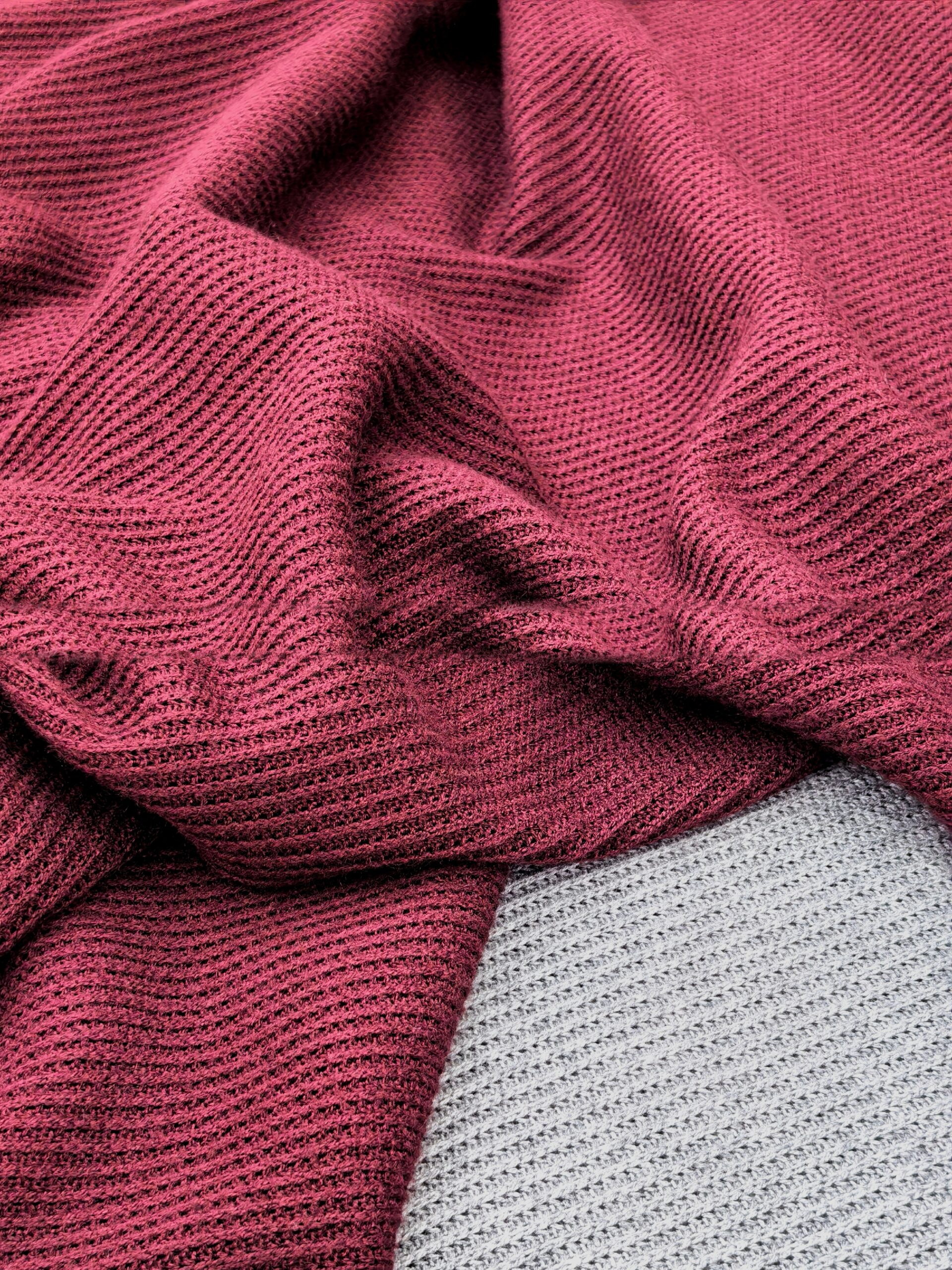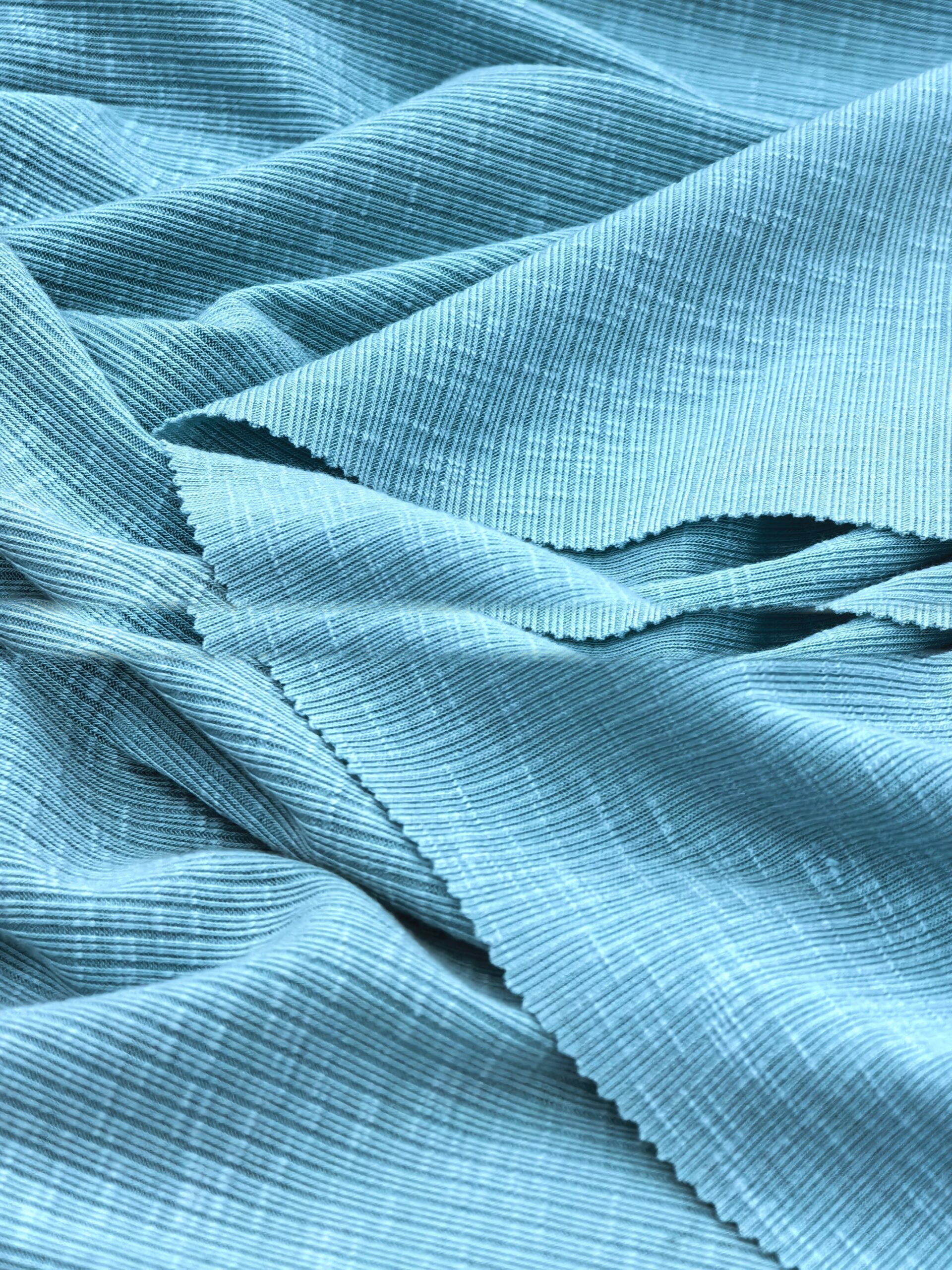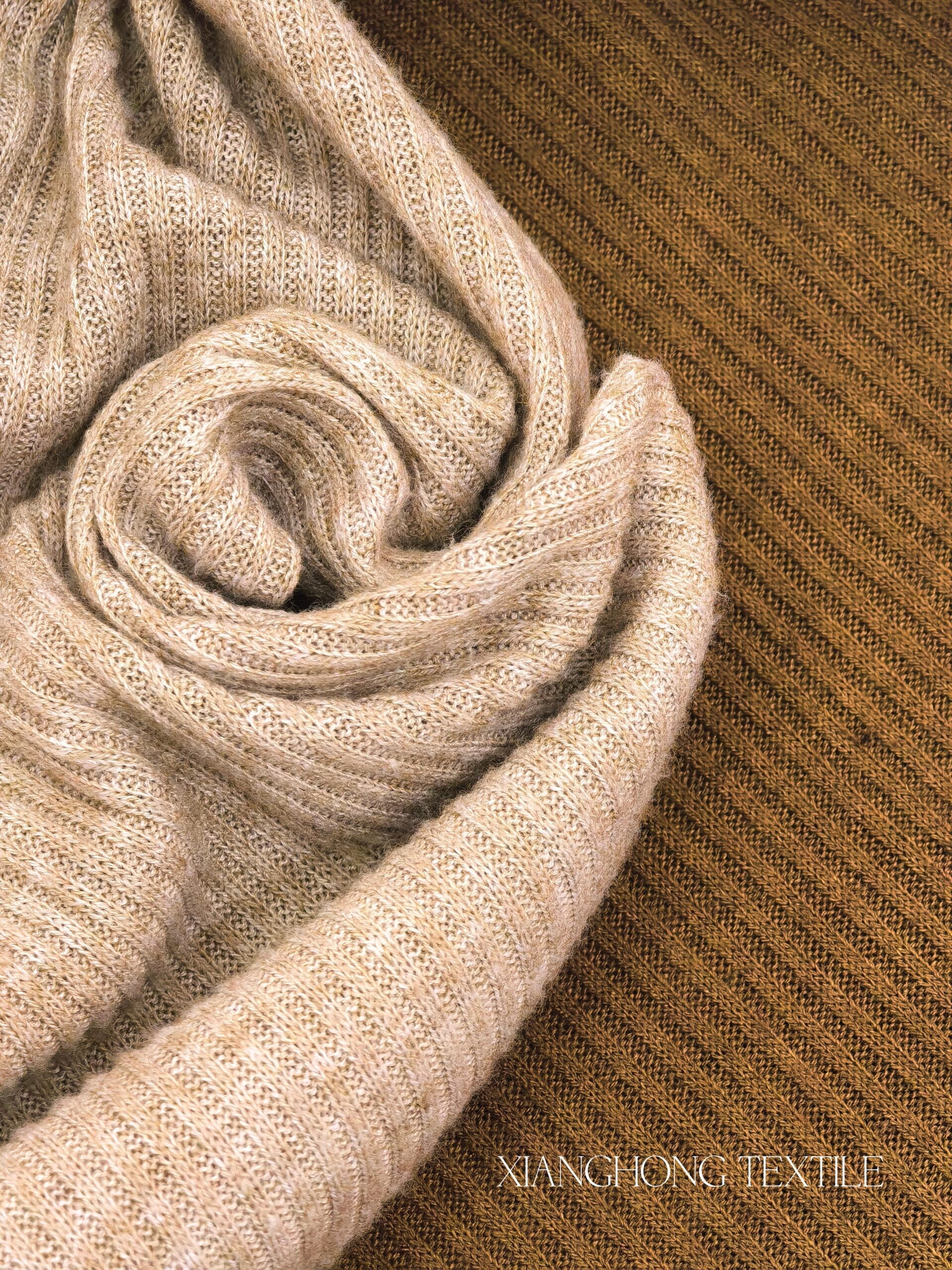
A cardigan rarely fails because the body fabric feels cheap. It fails at the places where two fabrics meet: the cuff that opens after a week, the placket that waves after pressing, or the hem band that is narrower than the front panel by the time it reaches the cutter.
That is why buying “a 280 gsm knit for cardigans” is not a complete specification. A balanced cardigan programme usually needs a body cloth, a trim cloth, and a clear rule for how both change width after relaxation. The body may carry the cashmere-like surface; the trim has to do the harder mechanical job.
Our current 50-article womenswear range includes several fabrics that can play the body role and several that make better trims. Below is how we would separate them by garment block, then how we would specify recovery, placket behaviour and width before a bulk order.
Start with the cardigan block, not the fibre name
An oversized drop-shoulder cardigan and a fitted cropped cardigan do not need the same body cloth. At the same 280 gsm, a looped bouclé and a fine jersey already behave differently. Add a different lapel, pocket or hem band and the correct choice changes again.
Three practical blocks cover most womenswear developments:
- Soft oversized cardigan: the fabric should drape from the shoulder, support a wider placket and tolerate a loose body without looking spongy.
- Fitted knit cardigan: recovery and dimensional stability matter more than surface loft. The fabric must return after wearing at the elbow and button extension.
- Cardigan-jacket: the cloth needs a cleaner face, enough body to hold a lapel or pocket line, and a seam construction that can be pressed without shine.
Once the block is fixed, place the fabric into one of the ranges below. The gsm bands are a starting point, not a promise: surface structure can add warmth or bulk without changing the measured weight.
210–240 gsm: compact cardigans and layering styles
This is the band for fitted cardigans, twin sets, cropped button-throughs and fine-gauge knit jackets. The cloth needs to recover rather than rely on volume. A high-elongation rib can feel substantial in the hand but still collapse at the front placket if recovery is poor.
#7803 Slim Ribbed High-Stretch Knit is 230 gsm at 165 cm and is aimed at close-fitting bodies. #2290 Fine Narrow Ribbed Stretch Knit is lighter at 210 gsm and has the fine vertical line that suits a neat neckline and narrow placket. #2369 Star Ribbed Linear Stretch Knit sits at 250 gsm on a 160 cm width, so the extra visual texture comes with a smaller cutting width.
For a cardigan with a decorative body but a cleaner trim, #2416 2×2 Rib Knit with Silver Lurex Accent at 240 gsm can work as an all-over statement or as a narrow placket accent. The metallic yarn changes the trim brief: do not fold it against a sharp edge and expect the same crease behaviour as a plain rib.
At this weight, do not assume a heavier trim is safer. A 280 gsm trim on a 220 gsm body can pull the front panel shorter at the hem, especially after washing. The trim should be selected for extension, recovery and width at the finished garment, not simply matched by weight.
250–280 gsm: the main cardigan body range
The middle of the range offers the widest choice of cashmere-like surfaces. #2406 Classic Cable Texture Knit Fabric has a raised cable structure at 280 gsm and 165 cm. The cable ridge adds local thickness, so the garment may wear warmer than a flat 280 gsm jersey without weighing more.
#2409 Boucle Wool-Blend Looped Knit is also 280 gsm at 165 cm. Its looped face is visually soft, but the loops can add bulk in a narrow sleeve seam. For a boxy cardigan, that bulk is often acceptable; for a fitted sleeve with a deep armscye curve, it may need a reduced seam allowance and careful grading.
If the design needs a more tailored surface, #2407 Chevron Arrowhead Texture Wool Blend Knit uses a directional arrowhead structure at 280 gsm and 165 cm. Pattern position matters. The chevron can centre beautifully on a straight front panel, but opposing panel directions can make a side seam look mismatched.
For a softer, more casual surface, #2527 Brushed Fuzzy Starry Texture Knit and #2533 Meteor Shower Jacquard Pattern Knit both sit at 280 gsm. The first is a brushed surface; the second builds pattern into the jacquard structure. Neither should be treated as a plain-goods substitute when the cutter is laying the marker.
Two hybrid constructions are useful when a ribbed cardigan looks too basic. #2201 Waffle-Rib Hybrid Texture Knit is 220 gsm at 165 cm, while #2209 Sculpted 3D Waffle Thermal Knit is 260 gsm. Both create shadow, but the deeper 3D grid in #2209 needs more attention at the cut edge and seam bulk.
For a softer corded surface, #2421 Soft Mochi Cord Ribbed Stretch Knit is 280 gsm at 165 cm. The cord direction should be marked on the pattern; a cuff cut across the cord will read differently from one cut along it.
300–400 gsm: cardigan-jackets and outerwear knits
Above 300 gsm, the garment starts to carry its own silhouette. This is useful for a cardigan-jacket with patch pockets, a wide lapel and a substantial hem, but it changes the seam plan. Four layers at an armhole are no longer a small detail.
- #2286 Chunky Euro-Cotton Velvet Textured Knit — 300 and 400 gsm, 165 cm. The textured velvet face needs a sample seam before the needle and foot pressure are fixed.
- #2367 Heavy Euro-Cotton Velvet Premium Knit — 380 gsm, 165 cm. A dense body cloth for a cleaner cardigan-jacket or an outer layer.
- #2260 Wheat Ear Texture Heavyweight Knit — 300 and 400 gsm, 160 cm. The vertical wheat-ear column can support a lapel or an open front without looking flat.
The smaller width on #2260 is not a minor specification. If the front and back panels are close to the marker width, a 160 cm cloth leaves less room for matching and edge loss than a 165 cm article. Price per kilogram is not the landed cost per garment until the marker has been tested.
The trim is a separate engineered component
For a button-through cardigan, price the body and trim as separate items even when they come from the same mill. The trim has four jobs: close the garment, recover after opening, survive the button or buttonhole, and keep the front edge visually straight.
A useful trim specification for a mid-weight cardigan is:
- Finished trim width chosen from the technical sketch, not estimated from the body fabric width.
- Extension and recovery measured after three cycles, not one pull by hand.
- Minimum recovery recorded with the time after release, for example 30 seconds and 5 minutes.
- Shrinkage measured in both directions after the agreed wash and dry method.
- Colour matched to the body under a defined light source, with the lab dip retained against the bulk.
- Needle marks, crease shine and edge curl checked after pressing.
A 2×2 rib, a fine 1×1 rib and a corded rib do not recover in the same way. #2170 Wide Chunky Ribbed Knit Fabric at 230 gsm and 160 cm is a different trim proposition from #2290 Fine Narrow Ribbed Stretch Knit at 210 gsm and 165 cm. One is a broader visual band; the other gives a finer edge and a different fold thickness.
For cuffs and waistbands, ask the trim supplier for the relaxed width and the maximum comfortable extension. If the cuff is cut to the wearer’s wrist circumference with no negative ease, it will have no holding power. If it is cut too small, the seam will sit proud and the sleeve may pucker. The right answer is found on a wear trial with the actual trim, not from a standard percentage copied between programs.
Placket behaviour: the detail that exposes unstable fabric
A front placket is essentially a long narrow strip with buttons and buttonholes. It amplifies every problem in the cloth: width variation, spirality, shrinkage and poor recovery. Before bulk, make a placket at least 30 cm long from the production roll and press it as the factory will press the finished garment.
Check three things:
- Straightness after relaxation: lay the placket on a flat table without stretching it. A curved edge will become a wavy front after washing.
- Buttonhole stability: cut the actual buttonhole in the actual trim and interlining. A clean sample on a plain rib does not guarantee a clean result on a fluffy or looped surface.
- Seam shadow: turn the sample to the inside. A thick folded edge may read through a light-coloured body and create a line down the front.
For a softer cardigan, a knitted-to-shape placket may be the better route. For a sharper cardigan-jacket, a more stable trim and carefully controlled pressing usually work better. The construction choice should be made before the fabric quantity is booked.
Width and cutting yield: 160 cm is not automatically cheaper
Most of the range is 165 cm wide, but several articles are narrower. Width affects the marker through the size grading, the number of panels across the lay, and the amount of matching waste on directional surfaces.
Run a simple comparison before comparing quotations. Take the largest two sizes in the range, place the actual pattern pieces on the quoted usable width, and include:
- selvedge exclusion;
- nap or pattern direction;
- side-seam allowance;
- placket and pocket pieces;
- end loss and defect allowance;
- the extra piece needed for a colourway or pattern match.
This is especially important for #2170 at 160 cm, #2260 at 160 cm and #2369 at 160 cm. A narrower cloth can still be the correct choice for a compact cuff or a small panel, but it should not receive a body-fabric price assumption without a marker check.
What we would sample for a cardigan programme
A practical pre-production sample pack contains:
- a 50 x 50 cm swatch of the body, washed and dried by the agreed method;
- a 30 cm placket made with the proposed trim, button and interlining;
- a cuff sewn on the actual sleeve, worn and flexed;
- a hem band attached to the body and left relaxed for at least 24 hours;
- a seam bulk sample at the sleeve, side seam and pocket;
- a retained sealed swatch signed by both buyer and mill.
That pack is more useful than comparing ten loose A4 cuttings. The cards show surface and colour; the constructed sample shows whether the cardigan will still look intentional after the customer wears it.
Stock, sampling and custom colour
The articles in this range can be sampled from stock. The confirmed minimum for ready stock is one roll, approximately 25–35 kg. Custom dyeing starts at 500 kg per colour. A4 swatch cards and hangers are available free of charge; the buyer covers freight.
If the body and trim need the same colour, ask for them to be submitted together. A colour that matches on paper can separate when one component is a looped surface and the other is a fine rib. The retained bulk swatch should be the reference, not a screen image.
Send us the cardigan sketch and tell us the target weight, trim width and order quantity. We can shortlist a body and trim from the current 50-article range, then send the relevant swatch set before you commit to a colour run.
Cardigan-range articles mentioned
| Article | Fabric | Weight | Width |
|---|---|---|---|
| #2170 | Wide Chunky Ribbed Knit Fabric | 230 gsm | 160 cm |
| #2369 | Star Ribbed Linear Stretch Knit | 250 gsm | 160 cm |
| #2416 | 2×2 Rib Knit with Silver Lurex Accent | 240 gsm | 165 cm |
| #7803 | Slim Ribbed High-Stretch Knit | 230 gsm | 165 cm |
| #2290 | Fine Narrow Ribbed Stretch Knit | 210 gsm | 165 cm |
| #2201 | Waffle-Rib Hybrid Texture Knit | 220 gsm | 165 cm |
| #2209 | Sculpted 3D Waffle Thermal Knit | 260 gsm | 165 cm |
| #2421 | Soft Mochi Cord Ribbed Stretch Knit | 280 gsm | 165 cm |
| #2406 | Classic Cable Texture Knit Fabric | 280 gsm | 165 cm |
| #2409 | Boucle Wool-Blend Looped Knit | 280 gsm | 165 cm |
| #2407 | Chevron Arrowhead Texture Wool Blend Knit | 280 gsm | 165 cm |
| #2527 | Brushed Fuzzy Starry Texture Knit | 280 gsm | 165 cm |
| #2533 | Meteor Shower Jacquard Pattern Knit | 280 gsm | 165 cm |
| #2286 | Chunky Euro-Cotton Velvet Textured Knit | 300 / 400 gsm | 165 cm |
| #2367 | Heavy Euro-Cotton Velvet Premium Knit | 380 gsm | 165 cm |
| #2260 | Wheat Ear Texture Heavyweight Knit | 300 / 400 gsm | 160 cm |
These 16 cardigan-relevant articles are part of the current 50-article in-stock range. Browse the complete knit fabric index to compare the dress, jacquard and lightweight options.
Related reading
- Choosing 250–400 gsm Cashmere-Feel Knits by Garment
- Rib Knit Fabrics Compared: 1×1, 2×2, Drop-Needle and Chunky Ribs
- How Loop, Cable and Chevron Stitches Build the Cashmere Look
- Cutting, Sewing and Pressing a Cashmere-Feel Knit Range
- Knit Fabric for Wool-Touch Dresses: Drape, Coverage and Lining
- Jacquard and Drop-Needle Knits for Cashmere-Feel Womenswear