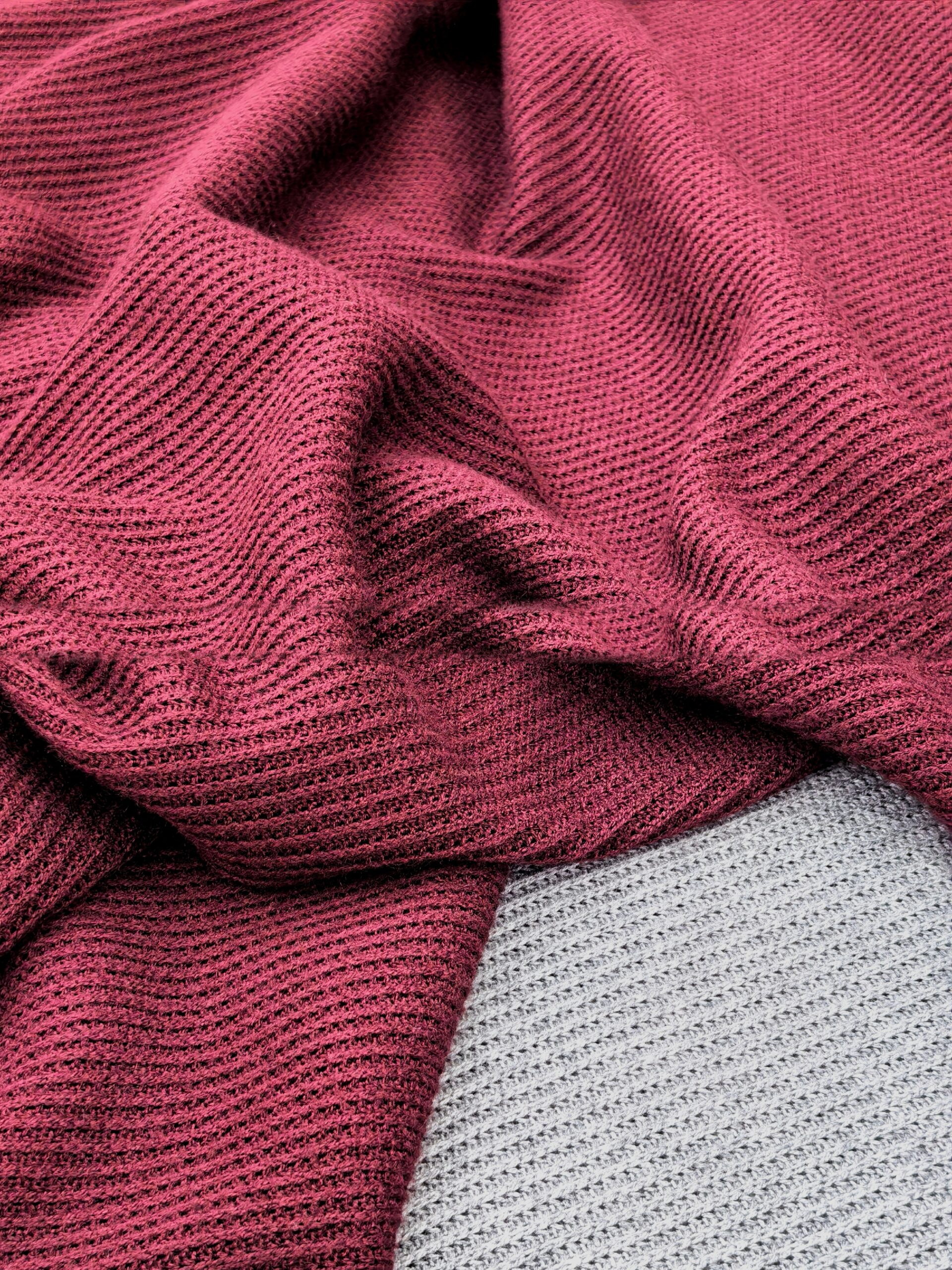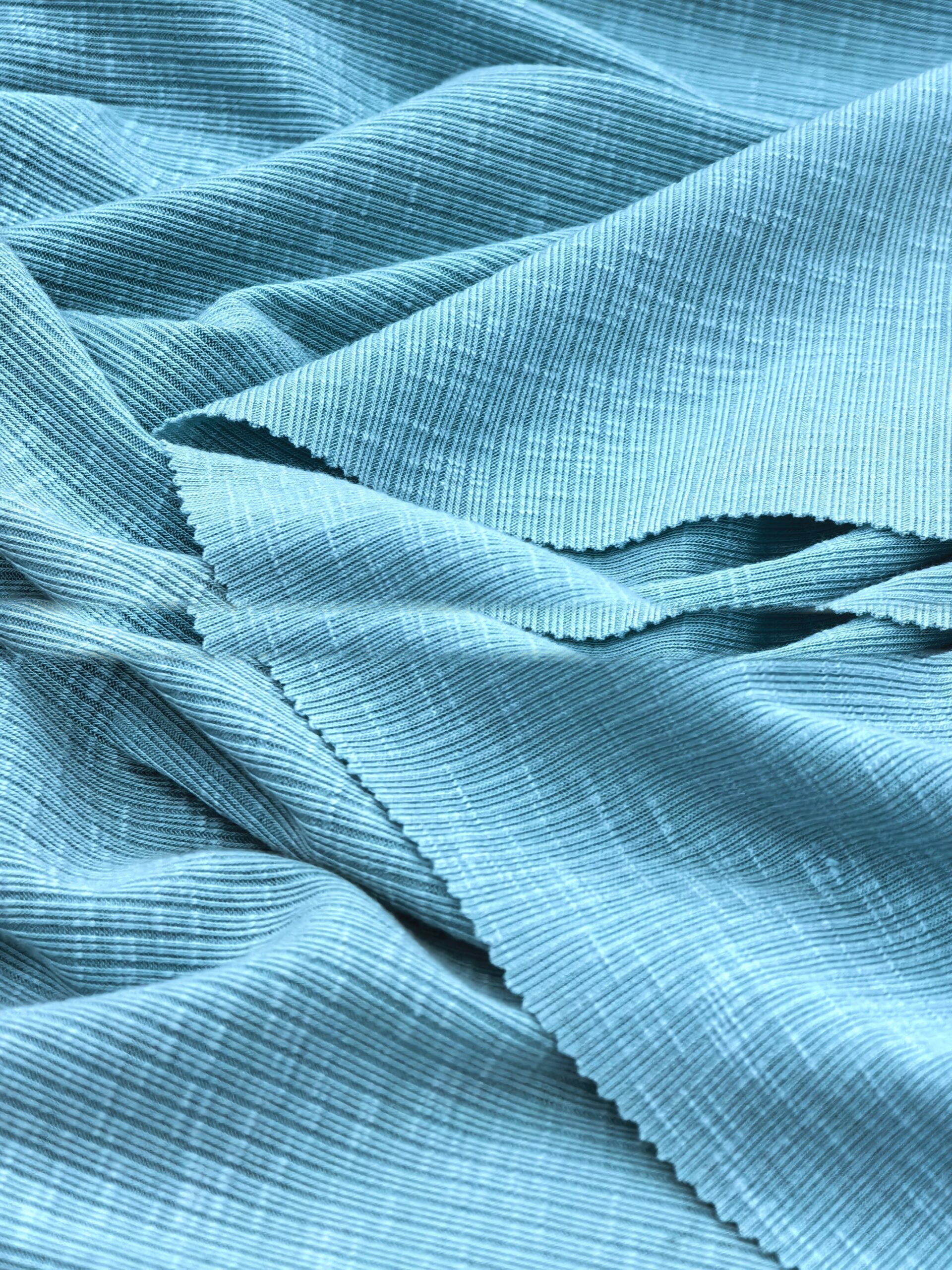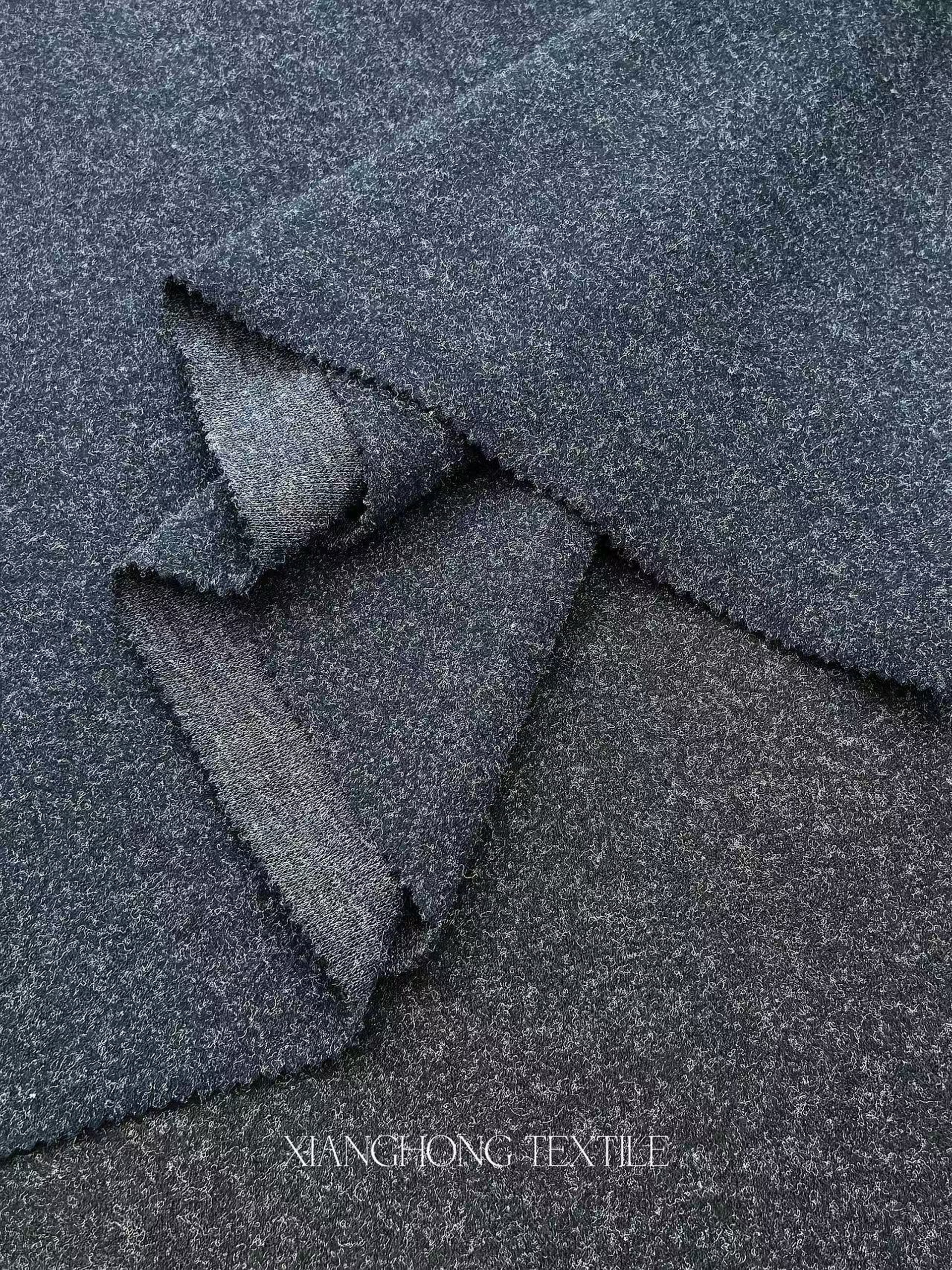
We have had the same conversation for years. A buyer approves a swatch, places an order, and then sends us a photo of the finished cardigan with a message that reads: it does not feel like the swatch.
Sometimes the mill is at fault. More often the fabric was fine when it left Keqiao and something happened between the cutting table and the final press. This article is about that gap, written for the people who will actually cut, sew and finish a 270–280 gsm cashmere-feel knit — not for a sourcing deck.
Four numbers that decide the programme
Before a single marker is made, four figures need to be on paper. Without them the sample room will guess, and the guess will be wrong in a different direction on each style.
- Shrinkage, length and width, after one domestic wash. Not “low shrinkage”. A number, measured on your own test method, in both directions.
- Width tolerance. If the quote says 165 cm, ask whether that is greige, finished, or usable between selvedges. On a 165 cm body panel, a 3 cm difference at the selvedge changes the marker.
- GSM tolerance. ±5% is normal. State it on the order so a 265 gsm delivery against a 280 gsm spec is a conversation rather than an argument.
- Spirality. Knit fabrics can skew after washing. Measure the leg of a trouser or the side seam of a dress after one wash, before you cut the bulk.
If you only take one number, take shrinkage. It is the one that turns a good fit sample into a returned bulk order.
Cutting: direction first, then speed
On brushed and looped surfaces the lay direction is not a preference. #2527 Brushed Fuzzy Starry Texture Knit has a raised surface; run the front panel one way and the back panel the other and the garment will read as two different colours under shop lighting even though it is one dye lot.
The rule we give cutters: one arrow on the pattern, one direction on the lay, and a chalk arrow on the top ply. For bouclé — #2409 — the same applies, and add a second rule about seam bulk. Bouclé at 280 gsm plus a 1 cm seam allowance gives you a ridge at the armhole that can be felt through a lining. Trim the allowance after overlocking rather than before.
Smooth structures are more forgiving. #2538 Silk-Touch and #2610 Acetate Wool can be laid two-up without a nap restriction, which is where the marker efficiency comes from. Do not carry that habit over to the brushed styles.
Sewing: the settings that keep the hand
Most of the damage to a knit happens at the needle. A sharp needle on a 270 gsm rayon-rich knit will cut the yarn, and the cut shows up three washes later as a line of small holes along the seam.
| Operation | Setting we recommend | Why |
|---|---|---|
| Needle | Ballpoint 75/11 for 250–280 gsm; 80/12 for 300 gsm and above | Rounded tip separates the yarn instead of cutting it |
| Stitch length | 3.0–4.0 mm on the main seam | Shorter stitches concentrate stress and pucker on stretch |
| Overlock | 4-thread, differential feed 1.1–1.3 | Prevents wavy seams on the cross grain |
| Hem | Coverstitch, 2-needle, 4–5 mm | Keeps recovery without a bulky fold |
| Thread | Polyester core-spun, tex 27–35 | Matches the elongation of the fabric |
Two of these are non-negotiable on cashmere-feel knits. First, the ballpoint needle. Second, the differential feed. A flat overlock on a 280 gsm rayon blend will produce a seam that waves along the side of the garment, and no amount of pressing removes it.
Pressing: the fastest way to lose the hand
A cashmere-feel knit gets its surface from raised fibre or from loop structure. Both are heat-sensitive, and both are destroyed by a flat, hot iron.
Press with steam at 110–130°C, from 10–15 cm, on a form or a sleeve board. Use a pressing cloth on dark shades. Do not rest the iron on the surface, and do not press a cable or a bouclé flat — a flattened cable cannot be recovered.
The exception is the seam. Seams can and should be pressed open, on a seam roll, before the garment is assembled. That is where pressing earns its money: it sets the seam so the garment hangs straight, without touching the surface.
A QC sequence that catches problems early
Run these in order. Each one is cheap; each one fails before the next becomes expensive.
- On receipt: measure width at three points across the roll and gsm on a 100 cm² cutter. Reject a roll that is out of tolerance before it reaches the lay.
- After cutting: check the first bundle for grain direction and ply alignment. One bad bundle is a re-cut; a bad lay is a re-order.
- After sewing: pull a side seam to 80% extension and release. A seam that does not recover will wave after the first wear.
- After washing: measure shrinkage and spirality on a finished garment, not on a square. The garment is what the customer sees.
- Before packing: press one garment and leave it on a hanger overnight. If the hand has stiffened by morning, the pressing temperature is too high.
Matching the article to the operation
The same sewing room can run all of these, but not with one setting:
- #2538 Silk-Touch Wool Blend Fine Knit — 270 gsm, 165 cm. Fluid drape, rayon-rich. Watch pressing shine; use a cloth.
- #2610 Acetate Wool Blend Porcelain Texture Knit — 280 gsm, 165 cm. Smooth surface, holds a soft shoulder. Good for blazers and skirt suits.
- #2527 Brushed Fuzzy Starry Texture Knit — 280 gsm, 165 cm. One-way lay, no flat press, lint control at the cutting table.
- #2409 Boucle Wool-Blend Looped Knit — 280 gsm, 165 cm. Seam bulk is the main risk; grade the allowance.
- #2406 Classic Cable Texture Knit Fabric — 280 gsm, 165 cm. Never press the cable flat; steam and cool on a form.
Sampling before the bulk
We ship A4 swatches free of charge, freight collect, and a swatch hanger if you are choosing between structures. One roll — about 25–35 kg — is the minimum for a fit sample, and stock ships in 24–48 hours. Custom dyeing starts at 500 kg per colour, with lab dips in 3–5 days.
If you are about to cut a first bulk and the four numbers at the top of this article are not yet on paper, ask us for them. We would rather send a shrinkage figure than replace a run.
Request a quote on #2538 — or send the tech pack and we will tell you which of these five we would cut it in, and where we expect the seam to give trouble.
Fabrics mentioned in this article
- #2538 Silk-Touch Wool Blend Fine Knit — 270 gsm, 165 cm
- #2610 Acetate Wool Blend Porcelain Texture Knit — 280 gsm, 165 cm
- #2527 Brushed Fuzzy Starry Texture Knit — 280 gsm, 165 cm
- #2409 Boucle Wool-Blend Looped Knit — 280 gsm, 165 cm
- #2406 Classic Cable Texture Knit Fabric — 280 gsm, 165 cm