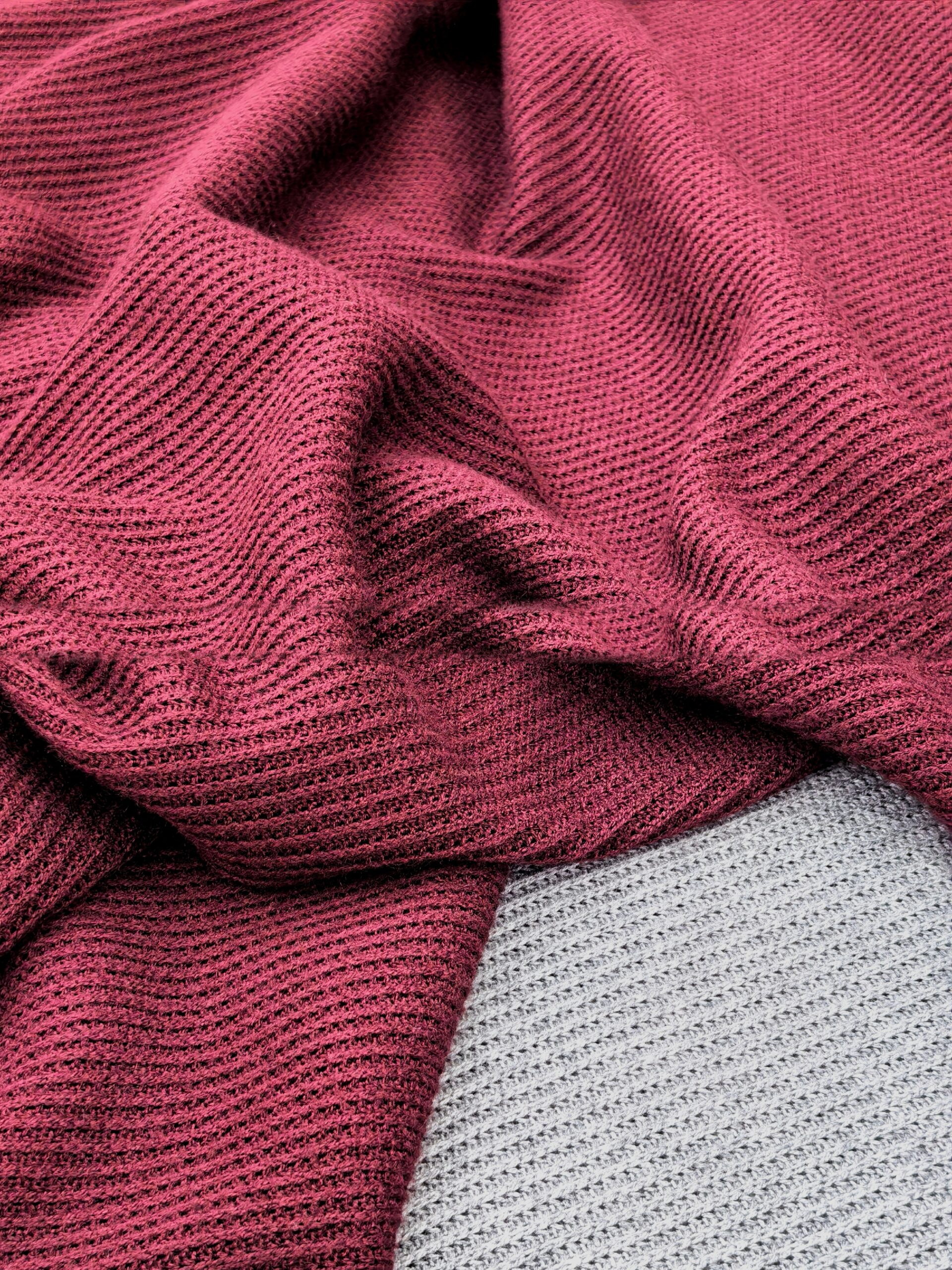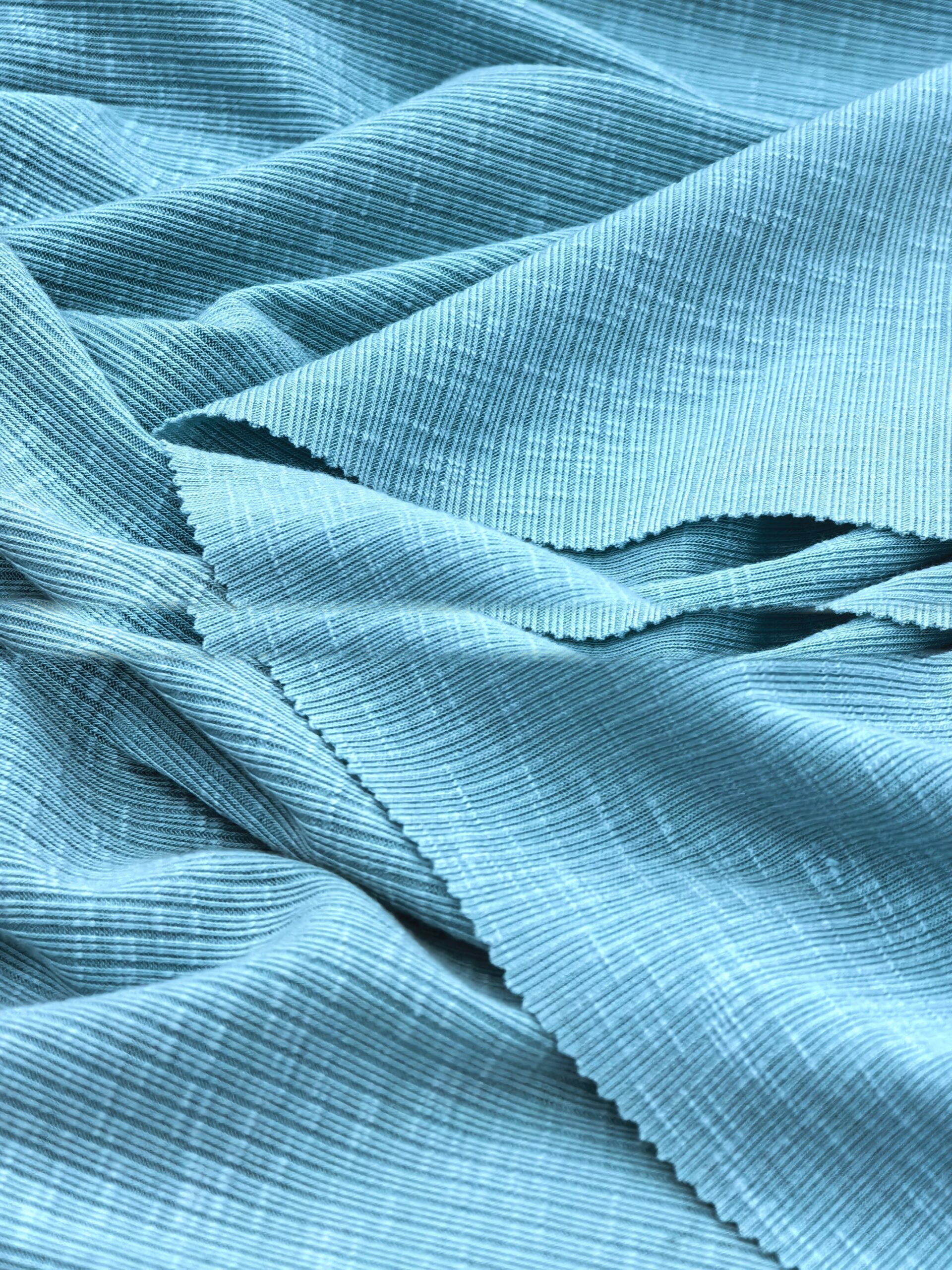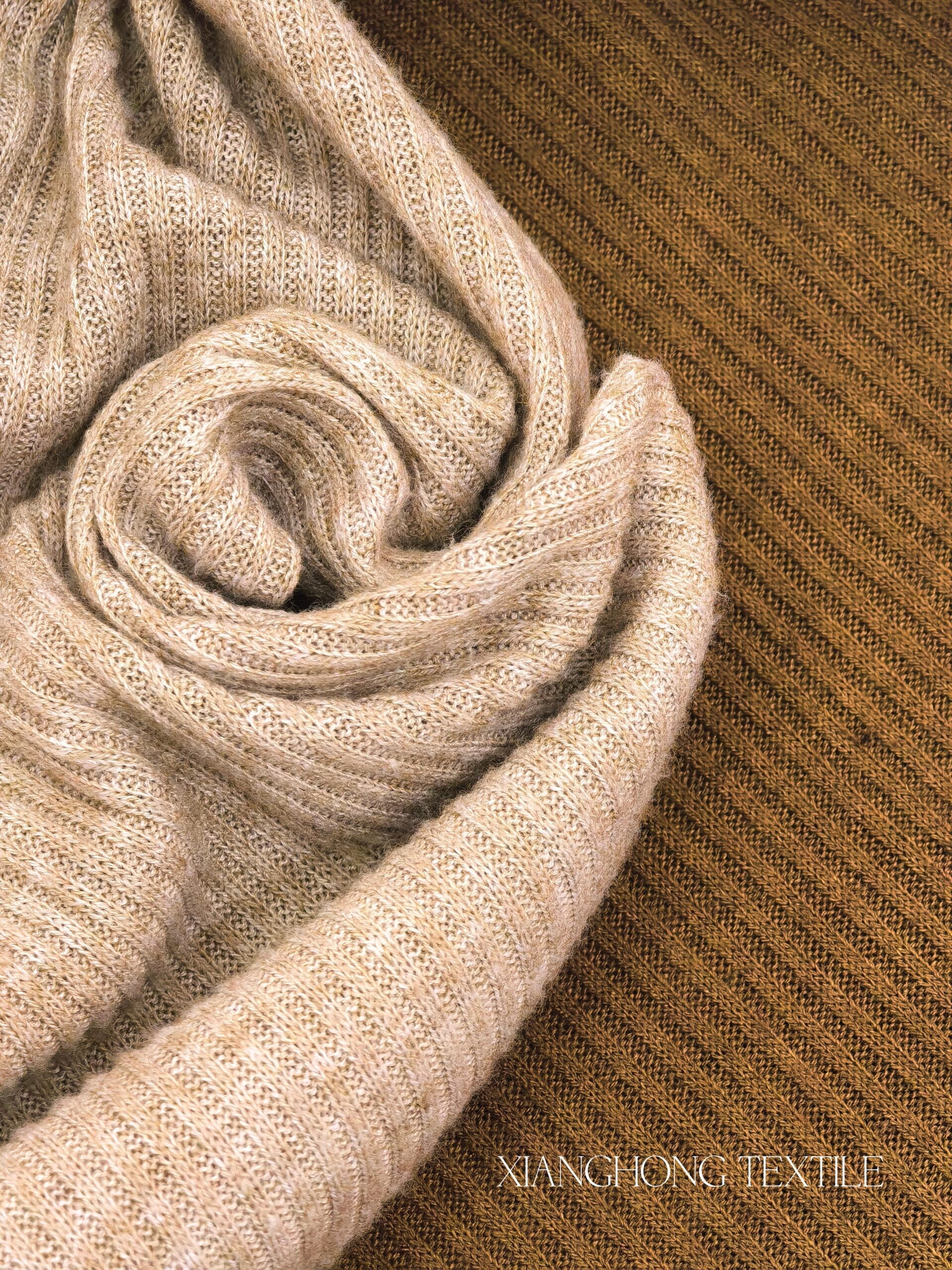
“Rib knit” covers a whole family of constructions, and the differences decide how a garment fits, how it recovers after washing and how much it costs to cut. When a buyer asks us for “a rib”, the first question is always: which one?
Here is how the four constructions we knit most often actually differ — written for buyers who have to write a spec that a factory can hit.
1×1 rib: the default choice
One knit stitch, one purl stitch, alternating. It is the most elastic common rib and recovers well, which is why it is the standard for cuffs, neckbands, hems and fitted tops. It is also the lightest and usually the cheapest rib to knit.
- Best for: trims, necklines, fitted tops, base layers.
- Watch out for: it can look thin on its own at low weights — below about 200 GSM it reads as a trim rather than a body fabric.
2×2 rib: more texture, less stretch
Two knit, two purl. The wider blocks give a more pronounced vertical line and a flatter, more stable surface than 1×1, at the cost of some elasticity. It is the classic choice for body-hugging dresses and tops where you want the rib to read as a design feature rather than a trim.
- Best for: fitted dresses, statement tops, co-ord sets.
- Watch out for: because it stretches less, size grading has to be checked against the actual garment — do not assume a 2×2 will behave like a 1×1.
Drop-needle and thermal ribs: the ones that look engineered
Drop-needle constructions remove selected needles to create a raised, sculpted surface — thermal ribs, star ribs, narrow-and-wide ribs. They are heavier, hold their shape well and photograph beautifully, so they sell strongly in autumn/winter ranges. They are also the slowest of the four to knit.
- Best for: knitwear with surface interest, winter dresses, cardigans, outer layers.
- Watch out for: print and embroidery sit unevenly on a raised surface — decide the decoration before you finalise the fabric.
Chunky and wide ribs: weight as a feature
Wide ribs — 2×2, 4×2 and beyond, knitted in heavier yarns — give the yarn-dyed, substantial hand that sells at a premium. They are the most forgiving for loose silhouettes and the least forgiving on a tight margin: they use more yarn per metre and cut slower.
- Best for: oversized knitwear, coats, statement sleeves.
- Watch out for: at heavy weights the usable width narrows and consumption per garment climbs quickly — always confirm GSM, width and shrinkage together.
The number buyers forget to specify: recovery
Two ribs with identical composition and GSM can behave completely differently after washing. Recovery depends on the yarn, the spandex percentage and the finishing, not just the construction. If the garment has to keep its shape after ten washes, put recovery in the spec — as a percentage after a defined wash cycle — and ask for the test report before bulk.
What width and weight to expect
Across our own range, rib knits run from about 180 GSM to 300 GSM, with cuttable widths between 150 cm and 185 cm depending on construction. Standard width is 165 cm; the narrower ribs and the heaviest chunky ribs are usually the ones that come in under it. Always take the width from the product page rather than assuming — it is the single number that changes your marker most.
A five-point sampling checklist
- Confirm construction (1×1 / 2×2 / drop-needle / chunky), not just “rib”.
- Confirm GSM and tolerance (±5% is normal; ask for it in writing).
- Confirm cuttable width after washing, not before.
- Confirm stretch direction and recovery after a defined wash cycle.
- Confirm colour on the final construction — the same dye lot reads differently on a 1×1 and a chunky rib.
Fabrics mentioned in this article
- #2170 Wide Chunky Ribbed Knit Fabric — 95% Polyester, 5% Spandex · 230 GSM · 160 cm
- #2369 Star Ribbed Linear Stretch Knit — 95% Polyester, 5% Spandex · 250 GSM · 160 cm
- #2290 Fine Narrow Ribbed Stretch Knit — 95% Polyester, 5% Spandex · 210 GSM · 165 cm
- #2397 4×2 Commercial Stretch Ribbed Knit — 70% Polyester, 30% Rayon · 185 GSM · 165 cm
Need samples or pricing?
Tell us the article number, colour and quantity and we will come back within 12 hours (Mon–Sat) with pricing, stock availability and lead times. Free A4 swatch cards and hangers are available — international freight collect.
Request a quote · See all 50 knit fabrics · Shop by category